
Blog
National Symbols of India: What Every Child Should Know

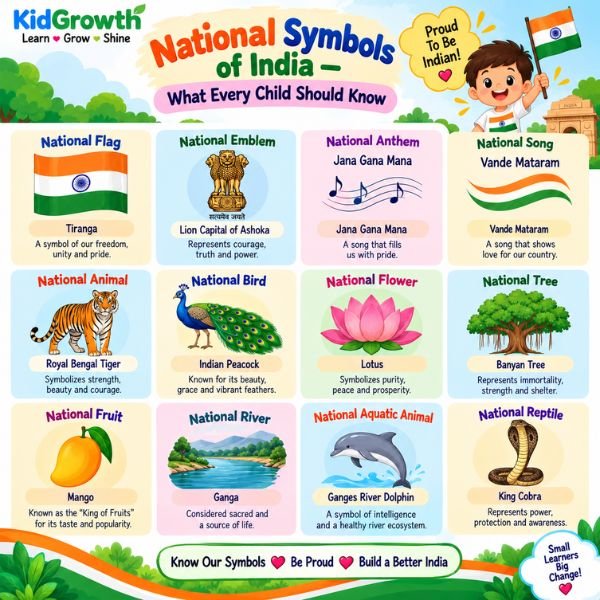
Every country has special symbols that represent its identity and pride, and India has a wonderful set of national symbols that every child should know. Learning about them builds both general knowledge and a sense of connection to the country.
In this post, we introduce India’s key national symbols in a simple, memorable way for young children.
India’s National Symbols at a Glance
| Symbol | Name |
| National Animal | Tiger |
| National Bird | Peacock |
| National Flower | Lotus |
| National Fruit | Mango |
| National Sport | Hockey |
| National Tree | Banyan Tree |
| National River | Ganga (Ganges) |
The National Flag
India’s national flag has three horizontal colours: saffron (courage and sacrifice) at the top, white (peace and truth) in the middle, and green (growth and prosperity) at the bottom, with a navy blue wheel called the Ashoka Chakra in the centre of the white band
The National Animal :Tiger
The tiger was chosen as India’s national animal for its strength, grace, and importance in India’s forests and wildlife. India is home to a large share of the world’s wild tiger population.
The National Flower : Lotus
The lotus grows in muddy water but blooms into a clean, beautiful flower a symbol often associated with purity and resilience in Indian culture.
The National Fruit : Mango
Mango is considered to be the ‘King of Fruits’ in India and has been selected as the national fruit because of its popularity, taste, and cultural importance.4
The National Sport : Hockey
Hockey holds a special place in India’s sporting history, with the Indian national hockey team winning multiple Olympic gold medals in past decades.
The National Bird : Peacock
The peacock is India’s national bird. Learn about its stunning feathers, unique appearance, natural habitat, cultural importance, and special place in Indian heritage.
How to Teach National Symbols to a Child : Step by Step
Step 1: Start With the Flag
The flag is usually the most familiar symbol. Teach the three colours and their meanings first, since children often already recognise the flag visually.
Step 2: Introduce One Symbol at a Time
Rather than teaching all symbols at once, introduce one per day or week — tiger, then peacock, then lotus — giving each time to be remembered clearly.
Step 3: Use Pictures and Visuals
Show real images or drawings of each symbol alongside its name. Visual association makes recall much easier for young children.
Step 4: Connect Symbols to National Days
Talk about national symbols especially around Independence Day (15th August) and Republic Day (26th January), when patriotic themes are naturally in focus.
Fun Ways to Practice National Symbols at Home
- Symbol Matching Cards — match each symbol’s name to its picture
- Colour the Flag — practice colouring the Indian flag correctly
- Symbol Quiz — ask simple questions like ‘What is India’s national animal?’
- Draw and Label — draw India’s key symbols and label each one
- National Symbols Worksheets — structured written and visual practice
Common Mistakes Children Make
- Mixing up the national bird (peacock) with other colourful birds
- Confusing the order or meaning of the flag’s colours
- Forgetting less familiar symbols like the national tree or river
- Not connecting symbols to their broader cultural or historical significance
When Do Kids Learn About National Symbols?
In most Indian school curricula (CBSE and ICSE), national symbols are typically introduced from Grade 1 onward, around age 6, as part of basic general knowledge and social studies content.
Practice Resources
Support your child’s learning with these free resources:
- National Symbols of India Worksheet — Structured practice on India’s key symbols
- GK Questions for Kids Grade 1 — Interactive quiz-based practice
FAQ
India’s key national symbols include the tiger (animal), peacock (bird), lotus (flower), mango (fruit), and hockey (sport), along with the national flag.
The tiger is India’s national animal, chosen for its strength and importance in India’s wildlife.
The Indian flag has saffron (courage and sacrifice), white (peace and truth), and green (growth and prosperity), with a navy blue Ashoka Chakra wheel in the centre.
National symbols are typically introduced from Grade 1 onward, around age 6, as part of basic general knowledge in Indian schools.
Learning national symbols builds general knowledge and a sense of connection to the country’s culture, history, and identity.