Blog
Community Helpers : Who They Are and What They Do for Kids

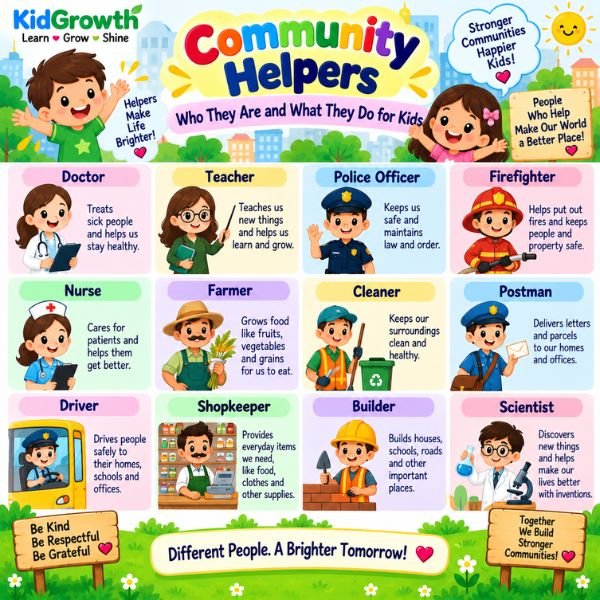
Community helpers are one of the most relatable early social studies topics for young children — they are the people your child sees and interacts with regularly, like teachers, doctors, and police officers.
In this post, we introduce the concept of community helpers and the most common helpers every child should know about.
What are Community Helpers?
Community helpers are people who do important jobs to help others in a community stay safe, healthy, educated, and cared for.
Common Community Helpers Kids Should Know
Doctor
Doctors help people who are sick or hurt get better. They check patients, give medicine, and help keep the community healthy.
Teacher
Teachers help children learn new things at school — reading, writing, math, and much more. They guide students to grow and understand the world.
Police Officer
Police officers help keep people and communities safe. They watch over neighbourhoods, help in emergencies, and make sure rules are followed.
Firefighter
Firefighters help put out fires and rescue people during emergencies. They also teach communities about fire safety.
Postman
Postmen deliver letters and packages to homes, helping people stay connected with others near and far.
Farmer
Farmers grow crops and raise animals that provide the food we eat every day, making them essential to every community.
Sanitation Worker
Sanitation workers collect garbage and help keep our streets and neighbourhoods clean and healthy.
Bus Driver
Bus drivers safely transport people to school, work, and other places, helping the community move around easily.
How to Teach Community Helpers to a Child : Step by Step
Step 1: Start With Helpers Your Child Sees Often
Begin with familiar figures like teachers and doctors, since your child already has personal experience with them.
Step 2: Explain Each Helper’s Job Simply
For each helper, explain in one simple sentence what they do and why it matters to the community.
Step 3: Connect Helpers to Real-Life Visits or Experiences
After a doctor’s visit or seeing a firefighter, talk about what that helper does and how they helped in that moment.
Step 4: Use Pictures and Costumes
Show pictures of each helper in their uniform, or let your child dress up and role-play as different community helpers.
Fun Ways to Practice Community Helpers at Home
- Community Helper Role-Play — dress up and act out different helper jobs
- Helper Matching Cards — match each helper to their tools or uniform
- Storytime Discussion — read books featuring community helpers and discuss their roles
- Helper Hunt — spot community helpers during outings and talk about their jobs
- Community Helpers Worksheets — structured written matching and identification practice
Common Mistakes Parents Make
- Introducing too many helpers at once instead of a few familiar ones first
- Not connecting helpers to real-life experiences your child has had
- Skipping the ‘why it matters’ explanation for each helper’s role
- Only using pictures without any hands-on role-play or discussion
When Do Kids Learn About Community Helpers?
In most Indian school curricula (CBSE and ICSE), community helpers are typically introduced in nursery through Grade 1, around age 4 to 6, as part of early social studies and general knowledge.
Practice Resources
Support your child’s learning with these free resources:
- Community Helpers Worksheet — Structured identification and matching practice
- GK Questions for Kids Grade 1 — Interactive quiz-based practice
FAQ
Community helpers are people who do important jobs to help others in a community stay safe, healthy, educated, and cared for, like doctors, teachers, and police officers.
Common community helpers include doctors, teachers, police officers, firefighters, postmen, farmers, sanitation workers, and bus drivers.
Start with familiar helpers your child already sees, like teachers and doctors, and explain each one’s role simply, connecting it to real-life experiences.
Community helpers are typically introduced from nursery through Grade 1, around age 4 to 6, as part of early social studies.
Learning about community helpers builds social awareness, gratitude, and an understanding of how different people work together to support daily life.