
Blog
Phonics vs Sight Words What Parents Should Know

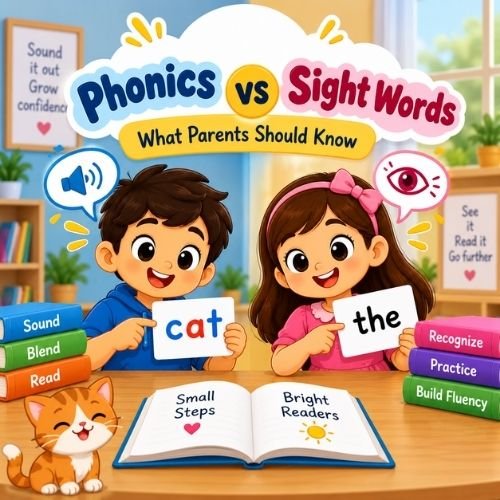
If you have looked into early reading methods, you have probably come across two common terms: phonics and sight words. Both play an important role in helping children become confident readers, but they teach reading in different ways.
Understanding phonics vs sight words for kids can help parents choose the right activities and support their child’s reading development at home.
Phonics vs Sight Words — Quick Comparison
| Phonics | Sight Words |
| Teaches letter sounds and how to blend them | Teaches whole words to be recognised instantly |
| Works for regular, predictable words | Used for irregular words that don’t follow phonics rules |
| Builds decoding skills for new, unseen words | Builds instant recognition for common, frequent words |
| Example: sounding out c-a-t to read ‘cat’ | Example: recognising ‘the’, ‘said’, or ‘was’ instantly |
| Main method for early reading instruction | A supporting method for words phonics cannot easily decode |
What is Phonics?
Phonics teaches children to connect letters with their sounds, and then blend those sounds together to read words. It works especially well for regular words that follow predictable spelling patterns, like CVC words (cat, dog, sun).
What are Sight Words?
Sight words are common words that appear frequently in reading but often do not follow regular phonics rules, making them hard to sound out. Words like ‘the’, ‘was’, ‘said’, and ‘of’ are usually taught as sight words — recognised instantly by sight rather than sounded out letter by letter.
Why Both Methods Are Needed
Neither phonics nor sight words alone is enough for strong reading. Phonics gives children the tool to decode new, unfamiliar words, while sight words help them read common irregular words quickly and fluently, without slowing down every sentence.
Should I Teach Phonics or Sight Words First?
Most reading experts and Indian school curricula recommend starting with phonics as the primary method, since it builds the core decoding skill needed for almost all future reading. Sight words are then introduced alongside phonics, specifically for the common irregular words phonics rules cannot easily explain.
How to Use Both at Home
Focus Most Practice on Phonics
Spend the majority of reading practice time on letter sounds and blending, since this skill transfers to reading thousands of new words over time.
Introduce Sight Words in Small Batches
Teach 3 to 5 common sight words at a time, using flashcards and repetition, focusing on words your child will see often in early reading books.
Combine Both in Reading Practice
When reading simple books together, let your child sound out regular words using phonics, and simply tell them sight words they have not yet memorised, building recognition through repeated exposure.
Common Mistakes Parents Make
- Trying to teach only sight words without a phonics foundation
- Trying to sound out irregular sight words using phonics rules, causing frustration
- Introducing too many sight words at once instead of small batches
- Not revisiting sight words regularly once introduced
When Are Phonics and Sight Words Taught?
In most Indian school curricula (CBSE and ICSE), phonics instruction typically begins in nursery or LKG, around age 4 to 5, with sight words introduced alongside phonics through Grade 1, around age 6.
Practice Resources
Support your child’s reading practice with these free printable worksheets:
- CVC Words Worksheet — Phonics-based blending practice
- Sight Words Grade 1 Worksheet — Common irregular word recognition practice
FAQ
Phonics teaches children to sound out words using letter sounds, while sight words are common irregular words taught for instant recognition since they do not follow regular phonics rules.
Most experts recommend phonics as the primary method first, since it builds decoding skills for most words, with sight words introduced alongside it for common irregular words.
Some common words like ‘the’ or ‘said’ do not follow regular phonics spelling patterns, making them easier to memorise as sight words than to sound out.
Yes, most effective reading programs teach both together — phonics as the main decoding tool, with sight words layered in for frequent irregular words.
Phonics typically begins around age 4 to 5, with sight words introduced alongside it through Grade 1, around age 6, in most Indian school curricula.