
Blog
What are CVC Words and How to Teach Them to Kids

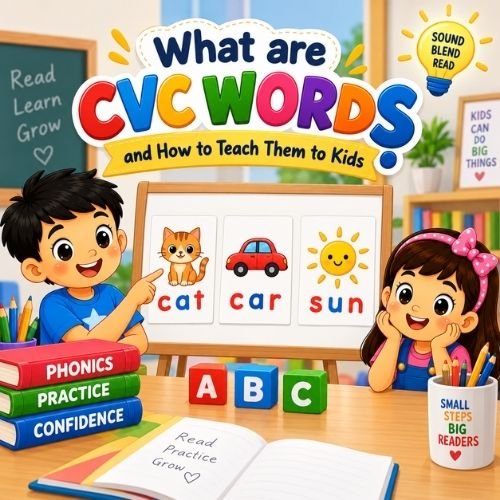
If your child’s teacher has mentioned ‘CVC words’ and you are not quite sure what that means, you are not alone. CVC words are one of the very first building blocks of reading, and understanding them will help you support your child’s early phonics journey.
In this post, we explain CVC words in simple terms and share an easy way to teach them at home.
What Does CVC Mean?
CVC stands for Consonant-Vowel-Consonant. It describes simple three-letter words where the first and last letters are consonants, and the middle letter is a vowel.
Examples of CVC words: cat, dog, sun, pen, bag, hop, mat, run.
Why CVC Words Matter for Early Reading
CVC words are usually the very first words children learn to read and sound out independently. Their simple, consistent pattern makes them the perfect starting point for teaching blending — combining individual letter sounds into a full word.
How to Teach CVC Words to a Child — Step by Step
Step 1: Make Sure Letter Sounds Are Solid
Before CVC words, your child should know the basic sounds each letter makes (not just the letter names). For example, ‘c’ makes a /k/ sound, ‘a’ makes a short /a/ sound.
Step 2: Start With Sound Blending
Show your child three letters — c, a, t — and say each sound slowly: /k/ /a/ /t/. Then say them faster together: ‘cat’. This blending process is the core skill behind reading CVC words.
Step 3: Use Simple, Familiar Words First
Start with words your child already knows the meaning of, like ‘cat’, ‘dog’, or ‘sun’. Familiar meanings make the blending process feel more rewarding and connected.
Step 4: Practice With Letter Tiles or Cards
Use physical letter cards to build CVC words. Swap out just one letter at a time — cat, bat, mat, sat — to show your child how changing one sound changes the whole word.
Step 5: Read CVC Words in Short Sentences
Once single CVC words feel comfortable, put them into very short sentences like ‘The cat sat on the mat.’ This builds reading fluency beyond isolated words.
Common CVC Word Families to Start With
- -at family: cat, bat, hat, mat, sat, rat
- -an family: can, fan, man, pan, van, ran
- -ig family: big, dig, fig, pig, wig, jig
- -og family: dog, fog, hog, jog, log
- -un family: sun, fun, run, bun, gun
Fun Ways to Practice CVC Words at Home
- Letter Swap Game — change one letter to make a new CVC word and read it out loud
- CVC Word Hunt — find CVC words on food packets, books, or around the house
- Build and Blend — use magnetic letters to build words on the fridge
- Picture Matching — match CVC words to pictures of the object they describe
- CVC Word Worksheets — structured written and reading practice
Common Mistakes Parents Make
- Teaching letter names instead of letter sounds first
- Moving to CVC words before individual sounds are solid
- Only doing worksheets without spoken blending practice
- Introducing too many word families at once
When Do Kids Learn CVC Words?
In most Indian school curricula (CBSE and ICSE), CVC words are typically introduced in Grade 1, around age 5 to 6, right after basic letter sounds are learned, as the foundation for early independent reading.
Practice Resources
Support your child’s CVC word practice with these free printable worksheets:
- CVC Words Worksheet — Structured blending and reading practice
- Three Letter Words Worksheet — Additional CVC word practice
- Beginning Sounds Worksheet — Builds the letter sound foundation for CVC words
FAQ
Start with individual letter sounds, then practice blending them together slowly and then faster, using familiar words your child already knows the meaning of.
CVC words are simple three-letter words that follow a consonant-vowel-consonant pattern, like cat, dog, or sun, and are usually a child’s first reading words.
Common examples include cat, dog, sun, pen, bag, hop, mat, and run.
Most children learn CVC words in Grade 1, around age 5 to 6, after mastering basic letter sounds.
CVC words have a simple, consistent pattern that makes them ideal for teaching sound blending, the core skill behind independent reading.