
Blog
Why Kids Struggle With Counting and How to Fix It

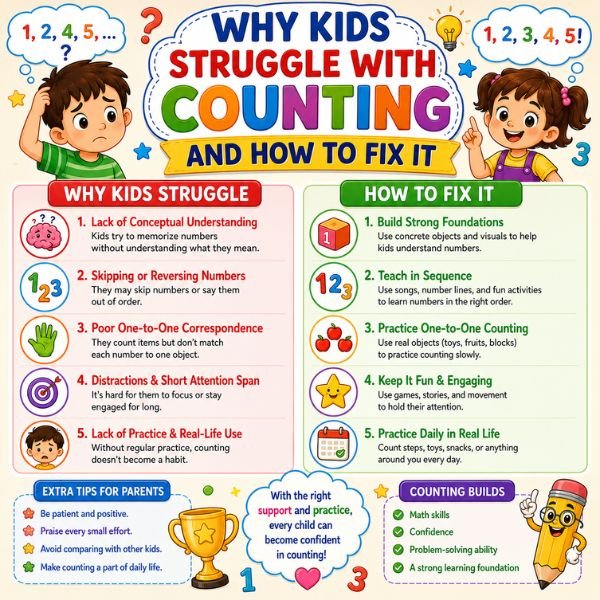
Does your child find it hard to count even simple numbers? You are not alone. Many parents face this challenge with young kids. Counting looks easy to adults, but for a child, it is actually a multi-step skill that takes time and practice.
In this post, we will look at the most common reasons why kids struggle with counting — and simple ways to fix each one.
Why Is Counting Hard for Some Kids?
Counting is not just about saying numbers out loud. A child needs to understand number order, match numbers to objects, and remember the sequence — all at the same time. That is a lot for a young brain to handle.
Here are the most common reasons kids find counting difficult.
1. They Do Not Understand One-to-One Counting
One of the biggest problems is that children say numbers too fast or too slow while pointing at objects. They might count ‘1, 2, 3’ but point at only two things — or skip an object entirely.
This is called one-to-one correspondence, and it takes practice to develop.
How to fix it: Ask your child to touch each object while counting it. Use physical items like buttons, coins, or small toys. Count slowly together so they match one number to one object.
2. They Do Not Remember the Number Sequence
Some children mix up the order of numbers. They might say ‘1, 2, 4, 3, 5’ without realising the mistake. This happens when numbers are not yet memorised in the correct order.
How to fix it: Repeat the number sequence daily through songs and rhymes. Counting songs like ‘1, 2, 3, 4, 5 — Once I Caught a Fish Alive’ make the order fun to learn. Practice counting from 1 to 10 every day, then move to 1 to 20 once confident.
3. They Struggle With Number Recognition
Some children can count verbally but cannot recognise what the number looks like when written. They may say ‘five’ but not identify the digit 5 on a page.
How to fix it: Use number flashcards and printed worksheets regularly. Matching the word ‘five’ to the digit ‘5’ and to five objects is a great three-way activity. Our counting worksheets are designed to help with exactly this.
4. They Lose Track While Counting Larger Numbers
Counting up to 10 may feel easy, but many children lose track when counting beyond that. They often skip numbers like 13, 14 or jump from 19 to 30.
How to fix it: Practice counting in short sessions every day. Start with 1 to 10, then 1 to 20. Do not rush to larger numbers. Consistent short practice works better than long sessions done rarely.
5. They Find It Hard to Count Objects in a Group
Counting a pile of scattered objects is harder than counting in a line. Children often recount the same object or miss one when things are not in order.
How to fix it: Teach your child to move each object to one side after counting it. This keeps track of what has been counted. Start with just 3–5 objects and increase the number slowly.
6. They Are Not Getting Enough Practice
Some children simply need more repetition than others. If counting is only done at school, it may not be enough.
How to fix it: Make counting part of daily life. Count stairs while climbing, fruits while washing, or shoes while putting them away. Even five minutes of counting practice at home each day makes a big difference over time.
Signs Your Child May Need Extra Help
- Cannot count to 10 by age 4 or 5
- Skips numbers consistently even after practice
- Does not understand that the last number counted is the total
- Confuses number names with number symbols
If these problems continue even after regular practice, speak to your child’s teacher for additional support.
Practice Resources
Help your child get better at counting with these free printable worksheets:
FAQ
Most children can count to 10 by age 4 to 5. Some may take a little longer — this is normal.
Yes, this is called ‘rote counting’ — saying numbers without understanding. Focus on counting real objects to build number sense.
Just 5 to 10 minutes of daily practice is enough for young children. Short and consistent works better than long sessions.
Not immediately. It is very common. Keep practising regularly. If the issue continues at age 6 or 7, speak with a teacher.
Yes, worksheets give structured practice. When combined with physical objects and daily counting games, they work very well.