
Blog
What is Multiplication — Simple Explanation for Kids

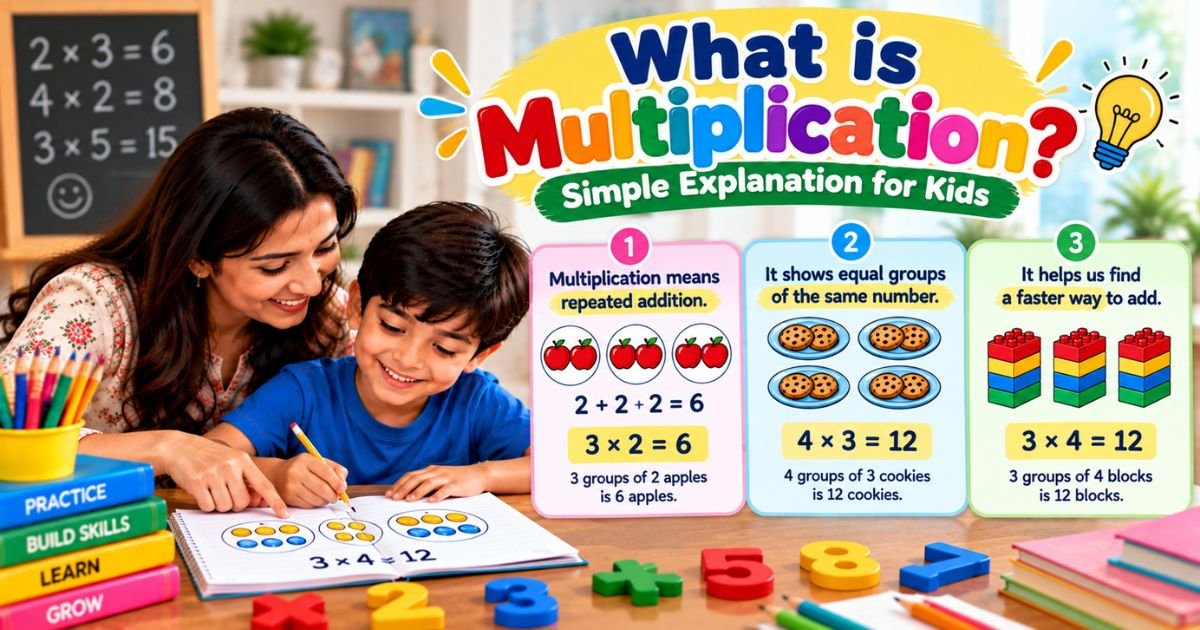
Multiplication is one of the four basic math operations children learn in school, usually introduced in Grade 2. But many kids first meet it as a wall of tables to memorise, without ever understanding what multiplication actually means.
In this post, we will break down multiplication in the simplest possible way, so your child understands the concept before memorising a single table.
What Does Multiplication Mean?
Multiplication means adding the same number a certain number of times, in one quick step.
In simple words: instead of adding 4 + 4 + 4 one at a time, multiplication lets us write 4 × 3 and get the same answer, 12, much faster.
Multiplication as Equal Groups
Another simple way to understand multiplication is through equal groups. If you have 3 plates, and each plate has 4 apples, multiplication tells you the total number of apples: 3 × 4 = 12.
This ‘equal groups’ idea is one of the most natural ways for children to first grasp multiplication, especially using objects they can count.
Multiplication as Arrays
An array is objects arranged neatly in rows and columns — like eggs in a tray. If a tray has 4 rows with 3 eggs in each row, multiplication tells you the total: 4 × 3 = 12.
Arrays are a powerful visual tool because your child can literally see the multiplication happening, row by row.
How to Explain Multiplication to a Child — Step by Step
Step 1: Start With Repeated Addition
Before introducing the multiplication sign, show your child sums like 5 + 5 + 5 and ask them to notice the same number is repeating. Point out this is exactly what multiplication is for.
Step 2: Introduce the Multiplication Sign
Once repeated addition feels familiar, introduce the ‘×’ sign as a shortcut: 5 + 5 + 5 becomes 5 × 3. Emphasise that both give the exact same answer, 15.
Step 3: Use Real Objects in Equal Groups
Give your child small objects like buttons or blocks. Ask them to make 3 groups of 4 buttons each, then count the total. This hands-on step builds real understanding, not just memorisation.
Step 4: Draw Simple Arrays
Draw dots in rows and columns on paper — 3 rows of 4 dots. Ask your child to count the total, then show how this matches 3 × 4.
Step 5: Connect to Skip Counting
If your child already knows skip counting by 2, 5, or 10, show that multiplication tables are simply skip counting written as a quick equation.
Multiplication in Everyday Life
- Buying 3 packets of biscuits with 6 biscuits each — how many biscuits in total?
- 4 friends, each with 2 balloons — how many balloons altogether?
- 2 rows of chairs, 5 chairs in each row — how many chairs in the room?
Pointing out multiplication in daily situations shows your child it is a useful real-world tool, not just a school topic.
Common Mistakes Children Make
- Confusing multiplication with addition, especially early on
- Memorising tables without understanding what multiplication actually represents
- Struggling to picture ‘equal groups’ when only shown numbers, without objects
- Mixing up which number represents the group size and which represents the number of groups
When Do Kids Learn Multiplication?
In most Indian school curricula (CBSE and ICSE), multiplication is introduced in Grade 2, typically around age 7 to 8, starting with the concept of equal groups and repeated addition before moving into tables.
FAQ
Tell your child that multiplication is a fast way to add the same number many times. For example, 3 + 3 + 3 is the same as 3 × 3.
Multiplication means combining equal groups to find a total quickly, instead of adding one group at a time.
Use buttons, blocks, or fruits arranged into equal groups, and ask your child to count the total. This builds understanding before introducing the multiplication sign.
Most children are introduced to multiplication in Grade 2, around age 7 to 8, once they are confident with addition and skip counting.
Yes, at this early stage, multiplication is best understood as a quick way to add the same number multiple times.