
Blog
What is Division — Easy Explanation for Kids and Parents

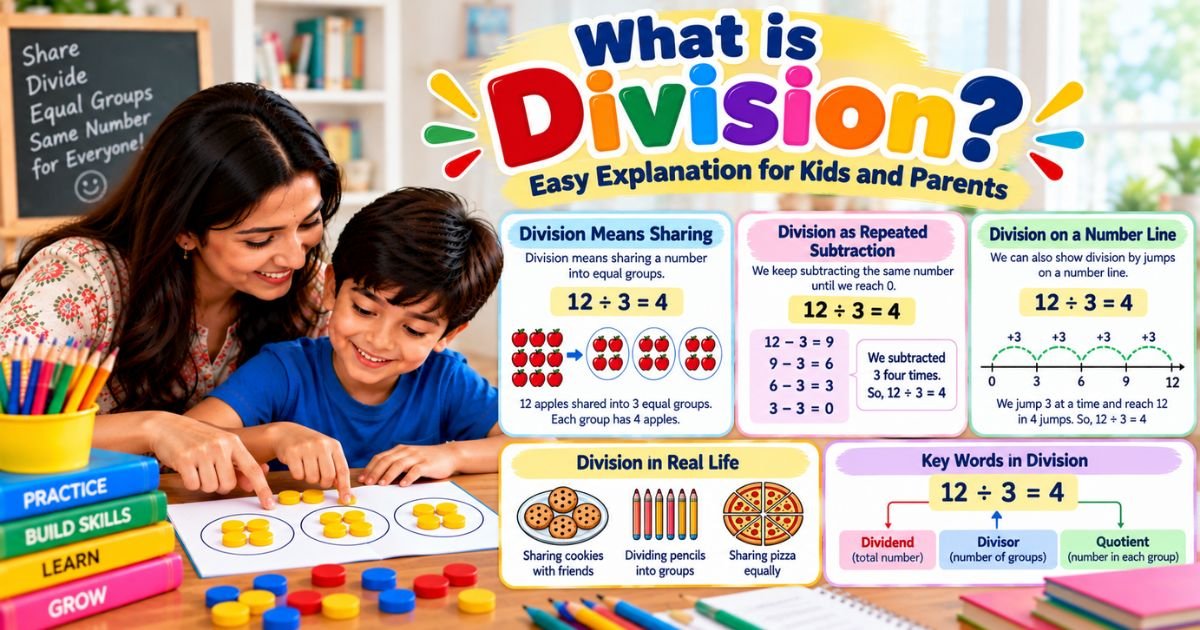
Division is the fourth basic math operation children learn, usually after addition, subtraction, and multiplication. It sounds technical, but at its heart, division is simply about sharing things equally.
In this post, we will explain what division means in the simplest possible way, and introduce the key terms parents and kids will come across.
What Does Division Mean?
Division means splitting a number into equal parts or equal groups.
In simple words: if you have a total amount and want to share it fairly among a certain number of people or groups, division tells you how much each one gets.
💡 Quick way to remember: division is the opposite of multiplication — one splits things apart, the other brings them together.
Division as Equal Sharing
Example: If you have 10 chocolates and want to share them equally between 2 children, division tells you each child gets 5 chocolates: 10 ÷ 2 = 5.
Division as Equal Grouping
Division can also mean splitting a total into groups of a certain size. Example: If you have 12 pencils and want to put them into boxes of 4 pencils each, division tells you how many boxes you need: 12 ÷ 4 = 3 boxes.
Key Division Words Explained Simply
- Dividend — the total number being divided (e.g. in 12 ÷ 4, the dividend is 12)
- Divisor — the number you are dividing by (e.g. in 12 ÷ 4, the divisor is 4)
- Quotient — the answer to a division problem (e.g. in 12 ÷ 4 = 3, the quotient is 3)
- Remainder — what is left over when a number does not divide evenly
How Division Connects to Multiplication
Division and multiplication are inverse operations — one undoes the other. If 4 × 3 = 12, then 12 ÷ 4 = 3 and 12 ÷ 3 = 4 automatically follow.
Encouraging your child to check division answers using multiplication builds confidence and reduces careless mistakes.
What is a Remainder?
Sometimes a number cannot be divided perfectly evenly. For example, 13 ÷ 4 gives 3 with 1 left over — the 1 is called the remainder. At this early stage, children first learn division without remainders before moving on to problems that do have remainders.
How to Explain Division to a Child Simply
- Use real objects like sweets, fruits, or toys for hands-on sharing
- Ask: ‘If we share this equally, how much does each person get?’
- Connect every division problem back to a multiplication fact your child already knows
- Introduce written division symbols only after the sharing concept feels natural
Common Mistakes Children Make
- Confusing division with subtraction, since both can involve ‘taking away’
- Struggling with the direction of the divisor and dividend in the equation
- Getting confused by remainders before basic even division is solid
- Not connecting division to multiplication facts, making recall harder
When Do Kids Learn Division?
In most Indian school curricula (CBSE and ICSE), division is introduced in Grade 2, typically around age 7 to 8, right after multiplication, starting with simple equal sharing and grouping.
FAQ
Tell your child that division means sharing something equally. For example, sharing 10 sweets between 2 friends means each friend gets 5.
Division means splitting a total number into equal parts or equal-sized groups.
The dividend is the total number being divided, the divisor is the number you divide by, and the quotient is the answer. In 12 ÷ 4 = 3, 12 is the dividend, 4 is the divisor, and 3 is the quotient.
Most children are introduced to division in Grade 2, around age 7 to 8, shortly after learning multiplication.
Division is the inverse of multiplication. If 4 × 3 = 12, then 12 ÷ 4 = 3 and 12 ÷ 3 = 4 automatically follow, which helps children check their answers.