
Blog
Singular and Plural Rules Easy Guide for Kids

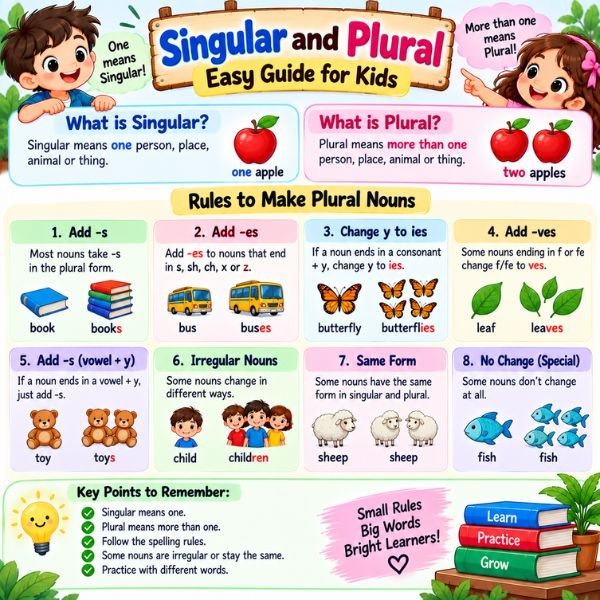
Once your child understands nouns, the next natural step is learning singular and plural forms — how words change when we talk about one thing versus many things.
In this post, we break down the basic rules of singular and plural nouns in a simple, easy-to-teach way.
What is Singular and Plural?
Singular means one — a single person, animal, or thing. Plural means more than one.
Example: one cat (singular) becomes two cats (plural).
The Basic Plural Rules
Rule 1: Add ‘s’ for Most Words
Most nouns become plural by simply adding ‘s’ to the end.
- cat → cats
- dog → dogs
- book → books
Rule 2: Add ‘es’ for Words Ending in s, x, ch, sh
Words that already end in certain sounds need ‘es’ instead of just ‘s’, so the plural is easier to pronounce.
- bus → buses
- box → boxes
- watch → watches
- brush → brushes
Rule 3: Change ‘y’ to ‘ies’ for Words Ending in Consonant + y
When a word ends in a consonant followed by ‘y’, change the ‘y’ to ‘i’ and add ‘es’.
- baby → babies
- city → cities
- puppy → puppies
Rule 4: Irregular Plurals Don’t Follow Rules
Some common words have completely irregular plural forms that need to be memorised separately.
- man → men
- woman → women
- child → children
- mouse → mice
- foot → feet
How to Teach Singular and Plural: Step by Step
Step 1: Start With Real Objects
Show one pencil, then two pencils, and say: ‘One pencil, two pencils.’ Physically counting objects makes the singular-plural difference concrete.
Step 2: Practice the Basic ‘s’ Rule First
Master the simple ‘add s’ rule with plenty of familiar words before introducing the trickier ‘es’ and ‘y to ies’ rules.
Step 3: Introduce ‘es’ and ‘y to ies’ Rules Gradually
Once the basic rule feels solid, introduce these patterns with a small set of example words, practicing each rule separately before mixing them.
Step 4: Treat Irregular Plurals as a Special List
Since irregular plurals don’t follow a pattern, treat them as a short memorisation list, practiced separately from the rule-based plurals.
Step 5: Practice in Sentences
Use both singular and plural forms in simple sentences: ‘I have one apple’ versus ‘I have three apples’, to reinforce the concept in a real context.
Fun Ways to Practice Singular and Plural at Home
- Object Counting Game — count real objects aloud, saying singular then plural
- Picture Sorting — sort pictures into ‘one’ and ‘many’ groups
- Plural Word Chain — take turns saying a singular word and its plural form
- Irregular Plural Flashcards — practice the special memorised list separately
- Singular and Plural Worksheets — structured written practice
Common Mistakes Children Make
- Adding just ‘s’ to words that need ‘es’ (like ‘boxs’ instead of ‘boxes’)
- Forgetting to change ‘y’ to ‘i’ before adding ‘es’
- Trying to apply regular rules to irregular plurals (like ‘mans’ instead of ‘men’)
- Mixing up singular and plural verb agreement in sentences
When Do Kids Learn Singular and Plural?
In most Indian school curricula (CBSE and ICSE), singular and plural rules are typically introduced in Grade 1, around age 6 to 7, shortly after basic nouns are established.
Practice Resources
Help your child practise with these free printable worksheets:
- Singular and Plural Worksheet — Structured rule-based practice
- Nouns Worksheet for Kids — Strengthens the noun foundation
FAQ
Most nouns become plural by simply adding ‘s’ to the end, like cat becoming cats. Special rules apply for words ending in certain letters.
Use real objects show one item, then two, saying ‘one pencil, two pencils’ to make the difference concrete before introducing spelling rules.
Irregular plurals don’t follow standard rules and must be memorised separately, like man becoming men, or child becoming children.
Most children learn singular and plural rules in Grade 1, around age 6 to 7, shortly after basic nouns are introduced.
Words ending in sounds like s, x, ch, or sh need ‘es’ instead of just ‘s’ so the plural form is easier to pronounce, like box becoming boxes.