
Blog
How to Use Dictation to Improve Kids’ Spelling at Home

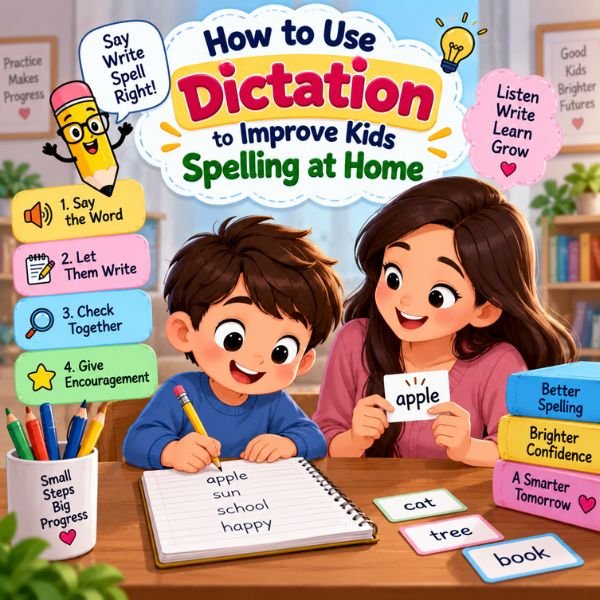
Dictation where you say a word or sentence aloud and your child writes it down is one of the most traditional and effective spelling practice methods used in Indian schools. It is also very easy to recreate at home.
In this guide, we will show you how to run effective dictation sessions with your child, step by step.
What is Dictation and Why Does It Work?
Dictation involves saying a word or sentence out loud, and asking your child to write it down correctly without seeing it first. This forces active recall of spelling, rather than passive copying, which builds much stronger, lasting memory of correct spellings.
How to Run a Dictation Session: Step by Step
Step 1: Choose a Focused Word List
Select 5 to 8 words your child has been practicing that week, ideally connected to their current phonics or spelling lessons at school.
Step 2: Say Each Word Clearly, Twice
Say the word clearly once, then repeat it a second time before your child begins writing. This helps ensure they heard it correctly, especially for less familiar words.
Step 3: Use the Word in a Simple Sentence
After saying the word, use it briefly in a sentence to clarify meaning — this is especially helpful for words that sound similar to others, like ‘their’ and ‘there’.
Step 4: Give Your Child Time to Write
Allow enough time for your child to write the word without rushing. Avoid hovering or correcting mid-word — let them complete their attempt first.
Step 5: Check and Review Together
Once the list is complete, go through each word together. For any mistakes, show the correct spelling and ask your child to write it correctly two or three times.
Step 6: Track Words That Need More Practice
Keep a simple running list of words your child consistently struggles with, and include them again in future dictation sessions until they are solid.
Progressing From Word Dictation to Sentence Dictation
Once single-word dictation feels comfortable, move to short sentence dictation like ‘The cat sat on the mat.’ This builds spelling within real writing context, along with basic punctuation and sentence structure awareness.
Tips for Effective Dictation Practice
- Keep sessions short — 5 to 10 minutes is enough for young children
- Stay calm and encouraging, even when mistakes happen
- Practice dictation 2 to 3 times per week for consistent progress
- Always review and correct mistakes together immediately after
Common Mistakes Parents Make
- Rushing through words too quickly without giving enough writing time
- Making dictation sessions too long, causing fatigue
- Not reviewing mistakes afterward, missing a valuable learning opportunity
- Using words that are too advanced for your child’s current level
When Should Dictation Practice Begin?
In most Indian school curricula (CBSE and ICSE), dictation is commonly used as a spelling practice method from Grade 1 onward, around age 6, once children are comfortable writing individual letters and simple words.
Practice Resources
Support your child’s dictation and spelling practice with these free printable worksheets:
- Spelling Words Grade 1 Worksheet — Word lists ideal for dictation practice
- Fill in the Blanks Spelling Worksheet — Reinforces spelling within sentence context
FAQ
Choose 5 to 8 focused words, say each one clearly twice with a sentence for context, give your child time to write, then review and correct mistakes together.
Yes, dictation builds active recall of spelling rather than passive copying, which creates much stronger and lasting memory of correct word spellings.
2 to 3 short sessions per week, around 5 to 10 minutes each, is usually enough for consistent, steady progress.
Dictation is commonly used from Grade 1 onward, around age 6, once children are comfortable writing individual letters and simple words.
Start with single-word dictation, and once that feels comfortable, progress to short sentence dictation to build spelling within real writing context.