
Blog
Division Word Problems — Step by Step Guide for Kids

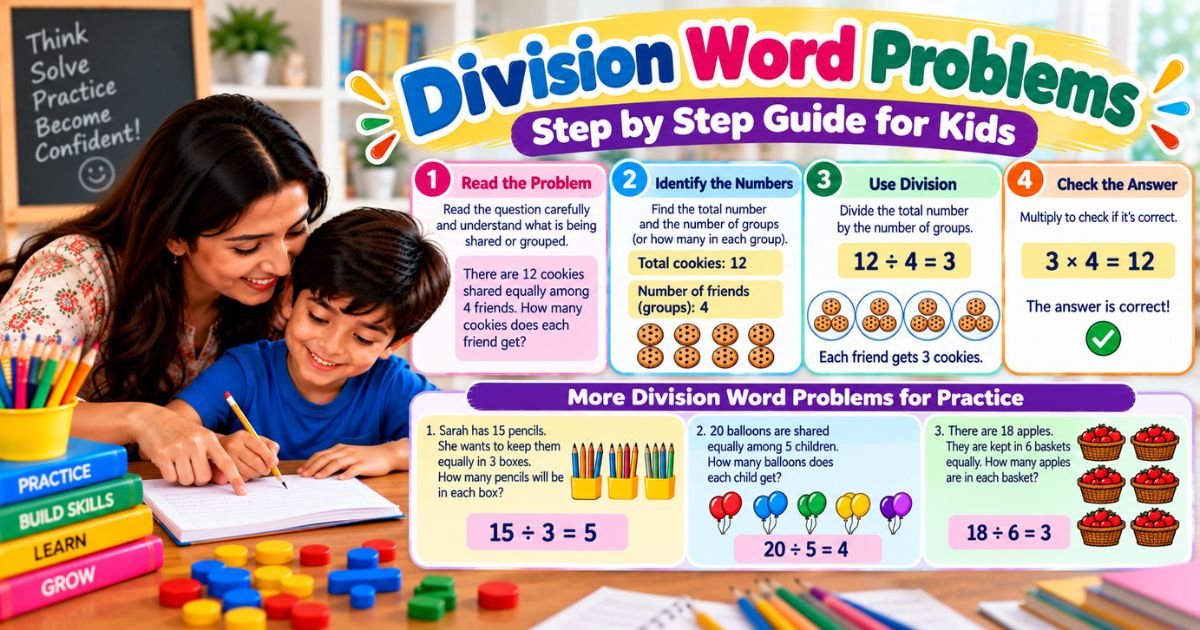
Just like addition, subtraction, and multiplication, division word problems can trip up children who otherwise know how to divide numbers correctly. The story format hides the operation, and children first need to figure out what is actually being asked.
In this guide, we will walk through a simple, repeatable method to help your child solve division word problems confidently.
Why Division Word Problems Feel Tricky
A written problem like 12 ÷ 3 is instantly recognisable. But a sentence like ‘Meera has 12 candies and wants to share them equally among 3 friends. How many candies does each friend get?’ hides the same operation inside a story.
Two Types of Division Word Problems
Type 1: Sharing Equally
These problems describe splitting a total among a known number of people or groups, and ask how much each one gets. Example: ‘Share 20 chocolates equally among 4 kids. How many does each kid get?’
Type 2: Equal Grouping
These problems describe a total and a known group size, and ask how many groups can be made. Example: ‘You have 20 chocolates and want to put 4 in each box. How many boxes do you need?’
Both types use the exact same division equation, 20 ÷ 4 = 5, but the story is asking a slightly different question — helping your child notice this builds much stronger comprehension.
Keywords That Signal Division in Word Problems
- Share equally, divide equally, split equally
- Each person, each group, each box
- How many in each
- How many groups, how many boxes
Step-by-Step Method to Solve Division Word Problems
Step 1: Read the Problem Twice
Read once for the story, and a second time specifically for numbers and clue words like ‘equally’ or ‘each’.
Step 2: Identify the Total and the Divisor
Ask your child: ‘What is the total amount?’ and ‘How many groups or how many in each group is mentioned?’ These become the dividend and divisor.
Step 3: Draw It Out
For younger children, draw circles for each group and distribute dots one by one, just like real sharing. This visual step makes the answer obvious.
Step 4: Write the Division Equation
Only after the picture is drawn, ask your child to write the equation: total ÷ number of groups (or group size) = answer.
Step 5: Check the Answer With Multiplication
Ask your child to multiply the answer back: if 20 ÷ 4 = 5, check that 5 × 4 = 20. This habit catches mistakes and reinforces the multiplication-division link.
Example Walkthrough
Problem: ‘A teacher has 18 pencils and wants to give an equal number to 3 students. How many pencils does each student get?’
- Total: 18 pencils
- Number of groups: 3 students
- Clue words: ‘equal number’ — signals division
- Equation: 18 ÷ 3 = 6
- Answer: Each student gets 6 pencils
Fun Ways to Practice Division Word Problems at Home
- Create sharing stories using real snacks or toys your child can physically divide
- Ask your child to make up their own division story for you to solve
- Turn everyday moments into problems: ‘We have 12 idlis for 4 people, how many each?’
- Use division word problem worksheets for structured, written practice
Common Mistakes Children Make
- Multiplying instead of dividing because the clue words were missed
- Confusing which number is the total and which is the divisor
- Skipping the picture step and guessing the equation directly
- Not checking the answer using multiplication
When Do Kids Learn Division Word Problems?
In most Indian school curricula (CBSE and ICSE), simple division word problems are introduced in Grade 2, typically around age 7 to 8, once children are confident with basic division and can read short sentences independently.
FAQ
This is usually a comprehension gap, not a math gap. The child can divide numbers but has trouble identifying the total and the divisor from the story.
Teach them to identify the total and the number of groups, draw a quick picture of the sharing, then write and check the equation using multiplication.
Sharing equally (splitting a total among a known number of people) and equal grouping (finding how many groups of a certain size can be made).
Most children begin with simple division word problems in Grade 2, around age 7 to 8.
Use real-life sharing situations like snacks or toys, and always ask your child to check the answer by multiplying it back to the original total.