
Blog
How to Improve General Knowledge in Kids at Home

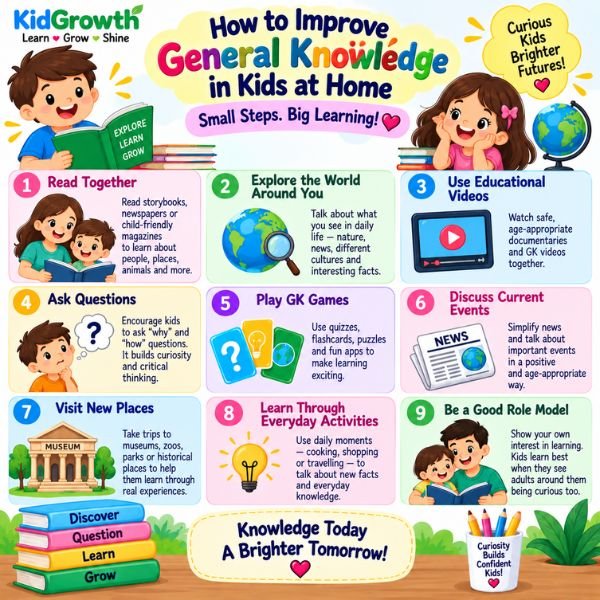
General knowledge is one of those skills that builds gradually, through curiosity and daily small habits, rather than through one big study session. The good news is that improving GK at home does not need to feel like extra homework — it can be genuinely fun.
In this guide, we share practical, easy-to-follow ways to build your child’s general knowledge at home.
Why General Knowledge Matters
- Builds broader awareness of the world beyond textbooks
- Supports better performance in school subjects like social studies and science
- Boosts confidence in conversations, quizzes, and competitions
- Encourages natural curiosity and a lifelong love of learning
How to Improve GK at Home : Step by Step
Step 1: Build a Daily Question Habit
Ask 3 to 5 simple GK questions during a meal, car ride, or bedtime routine. Small, consistent exposure builds knowledge far more effectively than occasional long sessions.
Step 2: Read Together Regularly
Books, especially those about animals, places, science, and history, naturally introduce new facts and vocabulary. Reading together also builds comprehension alongside knowledge.
Step 3: Use Everyday Moments as Learning Opportunities
Point out interesting facts during daily activities a rainbow after rain, different vehicles on the road, or seasonal changes turning ordinary moments into small learning experiences.
Step 4: Introduce Age-Appropriate Quizzes
Simple quiz formats, whether verbal or written, make GK practice feel like a game rather than a lesson. Celebrate participation and effort, not just correct answers.
Step 5: Explore One Topic Deeply at a Time
Rather than jumping between random facts, spend a week exploring one topic in some depth — like India’s national symbols, or animals of the world — building connected knowledge.
Step 6: Encourage Questions, Not Just Answers
When your child asks ‘why’ or ‘how’, treat it as a valuable learning moment. Look up answers together if you don’t know, modelling curiosity as a lifelong habit.
Fun Ways to Build GK at Home
- GK Quiz Nights — a weekly family quiz session with simple questions and small rewards
- Fact of the Day — share one new interesting fact with your child daily
- Topic Exploration Books — borrow or buy simple books on animals, space, or geography
- Documentary Watching — age-appropriate nature or science documentaries together
- GK Worksheets and Quizzes — structured practice to reinforce learned facts
Common Mistakes Parents Make
- Trying to cover too many random topics at once, without depth or connection
- Making GK practice feel like a test rather than a fun, curious exploration
- Being inconsistent — occasional long sessions instead of small daily habits
- Not celebrating curiosity and questions, focusing only on correct answers
When Should GK Learning Begin?
In most Indian school curricula (CBSE and ICSE), general knowledge learning begins informally from nursery, around age 3 to 4, and becomes more structured from Grade 1 onward as part of school curriculum and quizzes.
Practice Resources
Support your child’s GK growth with these free resources:
- GK Questions for Kids Grade 1 — Interactive quiz-based practice
- Community Helpers Worksheet — Focused topic-based GK practice
FAQ
Build a daily habit of asking simple GK questions, read together regularly, use everyday moments as learning opportunities, and introduce fun quizzes.
Weekly family quiz nights, a daily ‘fact of the day’, and topic-based books or documentaries make GK learning feel like play rather than study.
GK learning begins informally from nursery, around age 3 to 4, and becomes more structured from Grade 1 onward as part of the school curriculum.
Just 5 to 10 minutes of daily GK conversation or quiz practice, done consistently, builds strong knowledge over time.
General knowledge builds broader world awareness, supports school subjects like social studies, and encourages natural curiosity and confidence.