
Blog
How to Teach Nouns and Verbs to Kids in a Simple Way

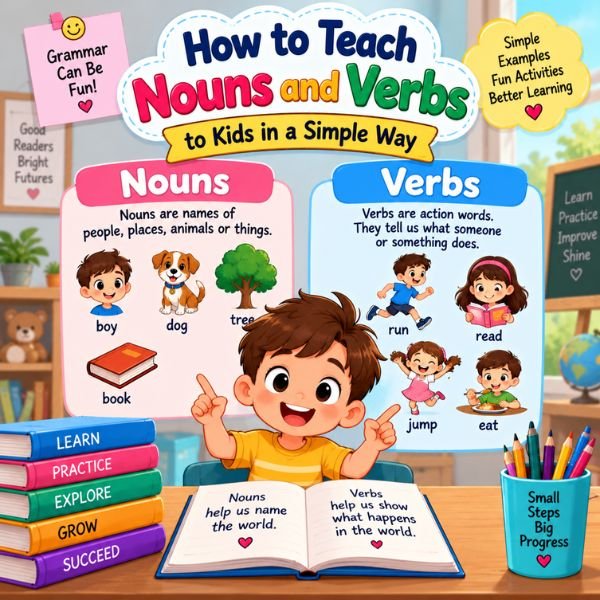
Grammar can sound intimidating, but nouns and verbs are actually concepts children already understand instinctively they just need simple, friendly labels attached to what they already know.
In this post, we will show you an easy way to introduce nouns and verbs to your child, without any confusing grammar jargon.
What is a Noun?
A noun is a naming word it names a person, place, animal, or thing.
Examples: boy, school, dog, ball, mother, park.
What is a Verb?
A verb is an action word it tells us what someone or something is doing.
Examples: run, jump, eat, sleep, read, sing.
How to Teach Nouns and Verbs: Step by Step
Step 1: Start With Nouns Your Child Knows Well
Point to familiar objects around the house — chair, table, cup, book — and say: ‘This is called a noun, it names a thing.’ Familiar objects make the concept click faster.
Step 2: Play ‘Point and Name’ for Nouns
Walk around the house or a park and ask your child to point at and name things they see. Confirm each one is a noun, building the pattern through repetition.
Step 3: Introduce Verbs Through Action
Ask your child to physically jump, run in place, or clap, and say the matching verb each time: ‘You are jumping! Jump is a verb.’ Physical movement makes verbs memorable.
Step 4: Play ‘Simon Says’ With Verbs
This classic game naturally reinforces action words — every instruction (‘Simon says jump’, ‘Simon says clap’) is a verb your child is actively identifying and performing.
Step 5: Build Simple Noun + Verb Sentences
Once both concepts feel familiar, combine them: ‘The dog runs.’ ‘The girl sings.’ Ask your child to identify which word is the noun and which is the verb in each sentence.
Step 6: Practice With Pictures
Show a picture and ask: ‘What is the noun in this picture?’ and ‘What action (verb) is happening?’ This builds the skill of identifying grammar in real, visual context.
Fun Ways to Practice Nouns and Verbs at Home
- Noun and Verb Sorting — sort word or picture cards into two piles
- Action Charades — act out a verb while your child guesses the word
- Story Time Spotting — pause while reading a book and ask your child to find a noun or verb on the page
- Draw and Label — draw a simple scene and label the nouns and verbs happening in it
- Nouns and Verbs Worksheets — structured written identification practice
Common Mistakes Parents Make
- Introducing grammar terms before the underlying concept is clear through examples
- Teaching nouns and verbs together too quickly without separate practice first
- Using abstract or unfamiliar words instead of everyday, familiar examples
- Skipping physical, hands-on activities for verbs, which are especially memorable
When Do Kids Learn Nouns and Verbs?
In most Indian school curricula (CBSE and ICSE), nouns and verbs are typically introduced in Grade 1, around age 6 to 7, as the foundational building blocks of basic grammar.
Practice Resources
Support your child’s grammar practice with these free printable worksheets:
- Nouns Worksheet for Kids — Identifying and using naming words
- Verbs Worksheet for Kids — Identifying and using action words
- Adjectives Worksheet for Kids — Builds on nouns with describing words
FAQ
Tell your child a noun is a naming word for a person, place, animal, or thing. Point to familiar objects around the house and name them together as practice.
Verbs are action words that describe what someone or something is doing, like run, jump, or eat. Acting out the action helps children remember the concept.
Most children are introduced to nouns and verbs in Grade 1, around age 6 to 7, as the basic building blocks of grammar.
Use familiar objects for nouns and physical actions for verbs, then combine both into simple sentences your child can practice identifying.
Games like noun and verb sorting, action charades, and spotting nouns or verbs during story time turn grammar practice into an enjoyable activity.