
Blog
Common Spelling Mistakes Kids Make and How to Correct Them

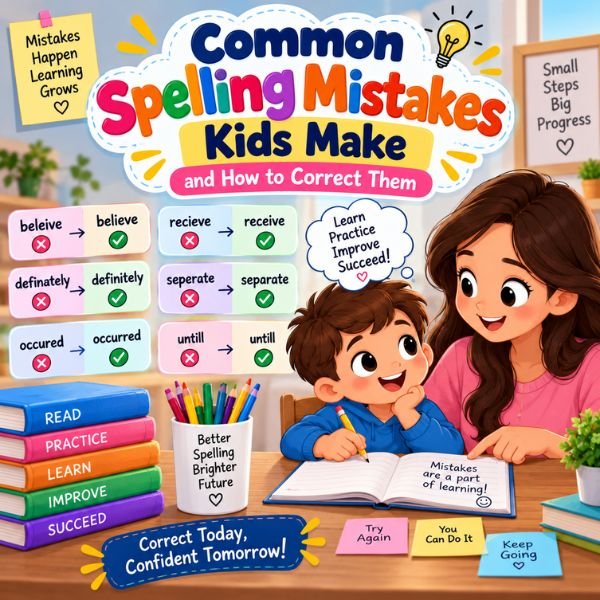
Certain spelling mistakes show up again and again in young children’s writing, across almost every classroom. Recognising these common patterns helps you target practice more effectively instead of guessing what to focus on.
Use this checklist to identify which common spelling mistakes your child makes, along with simple ways to correct each one.
Spelling Mistake Checklist
☐ Silent Letter Errors
Words with silent letters — like ‘knee’, ‘write’, or ‘comb’ — are commonly misspelled because the silent letter isn’t heard when sounding the word out.
- Fix: Point out the silent letter directly and practice these words as a special group, since phonics rules alone won’t cover them
☐ Double Letter Confusion
Words with double letters — like ‘little’, ‘happy’, or ‘butter’ — are often spelled with just one letter since the sound doesn’t clearly indicate doubling.
- Fix: Highlight the double letters visually (in a different colour) when practicing these specific words
☐ Short Vowel Confusion
Children often mix up short vowel sounds — writing ‘bad’ instead of ‘bed’, or ‘pin’ instead of ‘pen’ — since these sounds can be close together.
- Fix: Practice minimal pairs (bed/bad, pin/pen) side by side to sharpen the sound distinction
☐ Reversed Letters in Words
Just like reversing individual letters (b/d), children sometimes reverse letter order within words — writing ‘form’ as ‘from’, for example.
- Fix: Slow down writing and encourage sounding out each part of the word in order before writing
☐ Missing Letters
Children sometimes drop a letter entirely, especially in longer or less familiar words, like writing ‘frend’ instead of ‘friend’.
- Fix: Break the word into smaller syllables or sound chunks and write each part separately before combining
☐ Irregular Sight Word Errors
Common irregular words like ‘said’, ‘was’, or ‘of’ don’t follow standard phonics rules, so children often try to spell them phonetically and get it wrong.
- Fix: Treat these as memorised sight words rather than trying to sound them out using phonics rules
☐ Adding Extra Letters
Some children add extra letters that aren’t needed, especially when unsure of a word — like writing ‘wint’ instead of ‘went’.
- Fix: Use the Look, Cover, Write, Check method to build accurate visual memory of the correct spelling
How to Use This Checklist at Home
- Review a recent piece of your child’s writing and check off which mistake patterns appear most often
- Focus practice specifically on those 1 to 2 patterns for a couple of weeks
- Revisit the checklist periodically as spelling improves, to catch new patterns early
When Are These Mistakes Most Common?
In most Indian school curricula (CBSE and ICSE), these common spelling mistake patterns appear most frequently in Grade 1 and Grade 2, roughly ages 6 to 8, and naturally reduce with continued phonics and spelling practice.
Practice Resources
Support your child’s spelling accuracy with these free printable worksheets:
- Correct the Spelling Worksheet — Practice spotting and fixing common mistakes
- Spelling Words Grade 2 Worksheet — Structured practice for growing vocabulary
FAQ
Common patterns include silent letter errors, double letter confusion, short vowel mix-ups, reversed letters within words, missing letters, and irregular sight word errors.
Identify which specific pattern your child struggles with most, then target focused practice on that pattern using techniques like Look, Cover, Write, Check.
Silent letters aren’t heard when sounding a word out, so these words need to be practiced as a special memorised group rather than relying on phonics alone.
These patterns appear most frequently in Grade 1 and Grade 2, roughly age 6 to 8, and typically reduce with continued practice.
It is more effective to identify recurring patterns and focus practice there, rather than correcting every individual mistake in the moment, which can feel discouraging.