
Blog
My Child Struggles With Division — 5 Tips That Actually Work

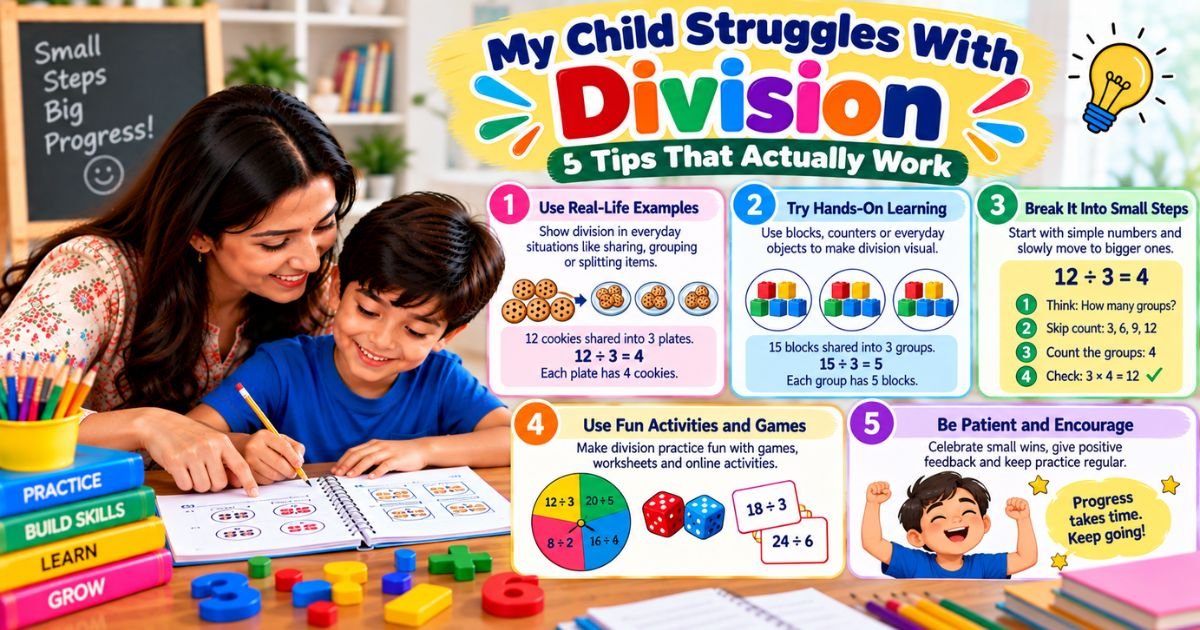
If division homework has become a daily struggle in your house, you are not alone. Division is the most complex of the four basic operations, and it is completely normal for children to need extra time and support with it.
In this post, we share 5 practical, proven tips that actually help children who are struggling with division.
Why is Division So Hard for Kids?
Division combines several skills at once — multiplication recall, subtraction, and the ability to think in reverse. If any one of these is shaky, division becomes noticeably harder.
Tip 1: Strengthen Multiplication Tables First
Division depends heavily on quick multiplication recall. If your child struggles to remember that 4 × 6 = 24, they will also struggle to solve 24 ÷ 4 or 24 ÷ 6. Spend extra time on tables 2 to 10 before pushing further with division.
Tip 2: Go Back to Hands-On Sharing
If written division feels overwhelming, step back to real objects. Give your child a group of items and ask them to physically share them equally. This rebuilds the concept from the ground up, without pressure.
Tip 3: Use the Multiplication-Division Connection
Teach your child to check every division problem using multiplication. For 20 ÷ 4, ask: ‘4 times what number equals 20?’ This reframes division as a multiplication puzzle, which many children find easier.
Tip 4: Slow Down and Use Small Numbers
Do not rush to bigger numbers or remainders. Stick with numbers that divide evenly and are within tables your child already knows well, until confidence builds.
Tip 5: Practice a Little, Every Day
Consistency matters far more than long sessions. Just 5 to 10 minutes of focused daily division practice — mixing objects, multiplication checks, and simple written problems — builds steady improvement over 3 to 4 weeks.
A Simple Daily Practice Routine
- 2 minutes: quick multiplication table recall (mixed, random order)
- 3 minutes: one or two hands-on sharing problems with real objects
- 5 minutes: 3 to 4 simple written division problems, checked using multiplication
Signs Your Child Needs More Support
- Freezes or avoids division homework specifically
- Can share objects correctly but cannot solve the same problem on paper
- Frequently mixes up which number is being divided and which is the divisor
- Still hesitant with multiplication tables, which is holding division back
Common Mistakes Parents Make
- Pushing written division before multiplication tables are solid
- Skipping hands-on sharing and going straight to worksheets
- Introducing remainders before basic even division is comfortable
- Expecting quick progress, when division naturally takes more time than other operations
When Should Division Difficulty Improve?
In most Indian school curricula (CBSE and ICSE), division is a Grade 2 topic, typically around age 7 to 8, and children are expected to take time building this skill. With consistent daily practice, most children show clear improvement within 3 to 4 weeks.
FAQ
Division depends on strong multiplication recall and reverse thinking. If either is shaky, division becomes noticeably harder — this is very common and fixable
Strengthen multiplication tables first, use hands-on sharing with real objects, and connect every division problem back to a multiplication fact.
Yes, division is generally the hardest of the four basic operations for young children, since it combines several other skills at once.
Break the problem into a multiplication question first — for example, 20 ÷ 4 becomes ‘4 times what equals 20?’ — which many children find easier to solve.
With 5 to 10 minutes of consistent daily practice, most children show clear improvement in division within 3 to 4 weeks.