
Blog
Multiplication Word Problems Easy Guide for Grade 2 Kids

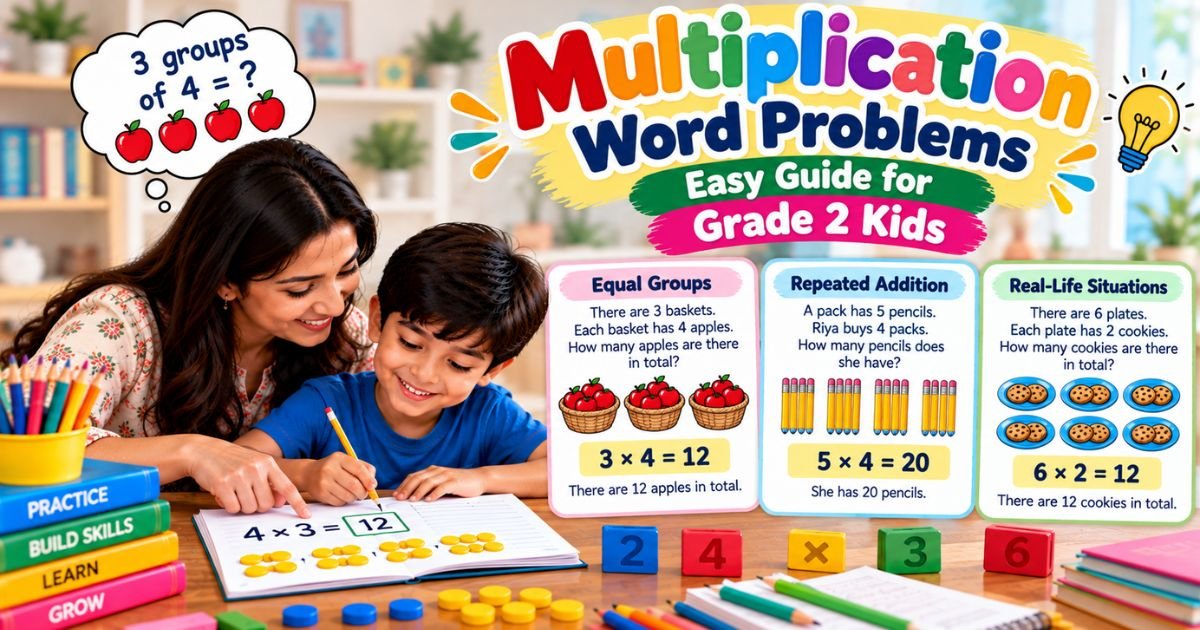
Just as with subtraction, many children who know their multiplication tables well still get stuck when the same problem appears in story form. ‘My child struggles with multiplication word problems’ is one of the most common concerns parents share.
In this guide, we will show you a simple, repeatable method to help your Grade 2 child solve multiplication word problems with confidence.
Why Multiplication Word Problems Feel Harder
A written problem like 3 × 4 is instantly recognisable. But a sentence like ‘There are 3 baskets with 4 mangoes in each. How many mangoes in total?’ hides the same operation inside a story, and the child first has to identify which operation is needed.
Keywords That Signal Multiplication in Word Problems
Teach your child to look for phrases that usually mean multiplication:
- Each, every (e.g. ‘each box has 5 pencils’)
- In total, altogether
- Times, groups of
- Rows and columns (arrays)
Spotting the word ‘each’ is often the single fastest clue that multiplication is needed.
Step-by-Step Method to Solve Multiplication Word Problems
Step 1: Read the Problem Twice
Read once for the story, and a second time specifically looking for numbers and the word ‘each’ or similar clue words.
Step 2: Identify the Group Size and Number of Groups
Ask your child two questions: ‘How many groups are there?’ and ‘How many are in each group?’ These two numbers are exactly what needs to be multiplied.
Step 3: Draw Equal Groups or an Array
For younger children, draw simple circles for groups with dots inside each, or a grid of rows and columns. Seeing the groups makes the multiplication obvious.
Step 4: Write the Number Sentence
Only after the picture is drawn, ask your child to write the multiplication equation: number of groups × size of each group = total.
Step 5: Check the Answer Makes Sense
Ask: ‘Does this answer make sense with the story?’ This habit catches careless errors and builds real understanding beyond just calculating.
Example Walkthrough
Problem: ‘A shopkeeper has 4 boxes. Each box has 6 chocolates. How many chocolates does he have in total?’
- Groups: 4 boxes
- Size of each group: 6 chocolates
- Clue word: ‘each’ — signals multiplication
- Equation: 4 × 6 = 24
- Answer: The shopkeeper has 24 chocolates
Fun Ways to Practice Multiplication Word Problems at Home
- Create stories using your child’s own toys, snacks, or school items
- Ask your child to make up their own multiplication story for you to solve
- Turn shopping trips into real problems: ‘3 packets of biscuits, 5 biscuits in each — how many in total?’
- Use multiplication word problem worksheets for structured, written practice
Common Mistakes Children Make
- Adding instead of multiplying because the clue word ‘each’ was missed
- Multiplying the wrong two numbers from the story
- Skipping the picture step and guessing the equation directly
- Not checking if the final answer actually matches the story
When Do Kids Learn Multiplication Word Problems?
In most Indian school curricula (CBSE and ICSE), simple multiplication word problems are introduced in Grade 2, typically around age 7 to 8, once children are confident with basic multiplication tables and equal-groups thinking.
FAQ
This is usually a comprehension issue rather than a math issue — the child knows how to multiply but has trouble identifying the group size and number of groups from the story.
Teach them to identify the number of groups and the size of each group, draw a simple picture or array, then write and check the equation.
Words like ‘each’, ‘every’, ‘in total’, ‘altogether’, and ‘groups of’ usually signal that multiplication is the operation needed.
Most children begin with simple multiplication word problems in Grade 2, around age 7 to 8.
Use real-life situations like shopping or sharing snacks, and ask your child to invent their own word problems for you to solve too.