
Blog
How to Teach Multiplication Tables to Kids Easy Tricks

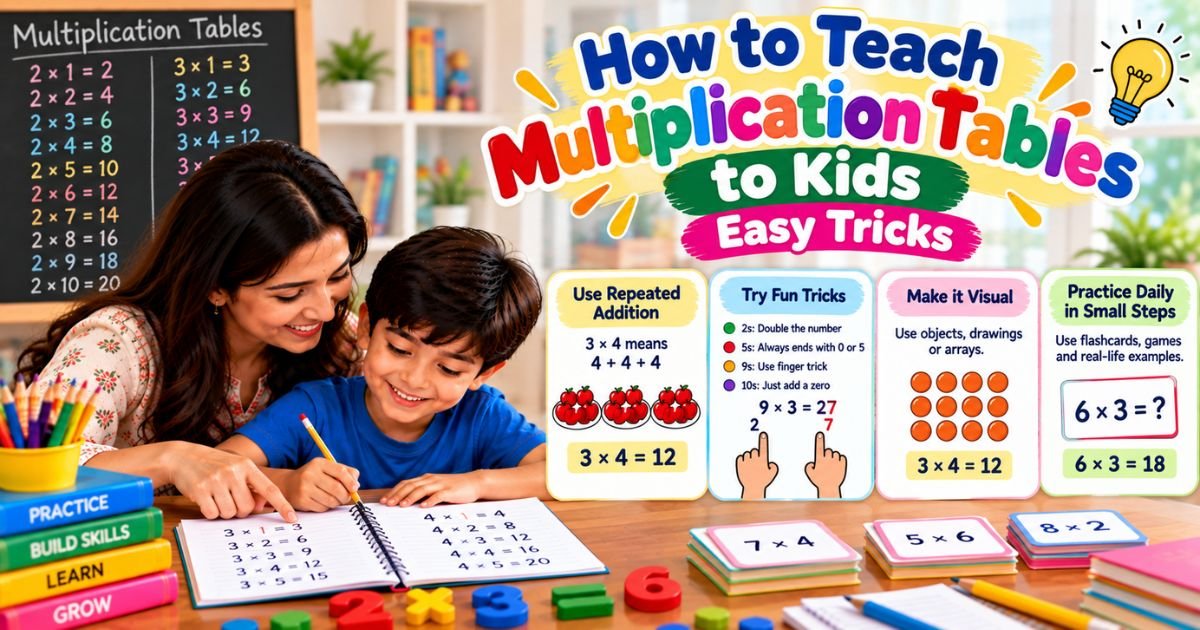
Multiplication tables are one of the biggest math milestones for young children — and often one of the most stressful for parents too. If your child is starting tables for the first time, the good news is that with the right approach, tables can be learned quickly and without tears.
In this post, we will show you simple, proven tricks to teach multiplication tables at home, starting from the very basics.
What is Multiplication, in Simple Words?
Multiplication is simply repeated addition. Instead of adding the same number again and again, multiplication lets us do it in one quick step.
Example: 3 + 3 + 3 + 3 = 12 is the same as 3 × 4 = 12.
The Best Order to Teach Multiplication Tables
Do not start with table of 2 just because it comes first. The easiest tables to learn first are the ones with the most obvious patterns:
- Table of 10 — easiest, just add a zero
- Table of 5 — every answer ends in 0 or 5
- Table of 2 — same as doubling, and connects to skip counting by 2
- Table of 4 — double the table of 2
- Table of 3 — needs a bit more practice, but manageable next
- Remaining tables (6 to 9) — build up gradually with tricks below
Easy Tricks for Each Table
Table of 2 — Just Double It
Table of 2 is simply doubling the number: 2 × 4 is the same as 4 + 4 = 8. If your child is confident with skip counting by 2, this table will already feel familiar.
Table of 5 — The Clock Trick
Every answer in the table of 5 ends in either 0 or 5. Use a clock face — each ‘five minute’ mark is a multiple of 5 (5, 10, 15, 20…). This visual is instantly familiar to children.
Table of 9 — The Finger Trick
Hold up all 10 fingers. To find 9 × 3, fold down the 3rd finger. The fingers before it show the tens digit (2), and the fingers after show the ones digit (7) — giving 27. This trick works for the entire table of 9.
Table of 10 — Just Add a Zero
Multiplying any number by 10 simply adds a zero at the end: 10 × 6 = 60. This is usually the fastest table for children to master.
Table of 11 (up to 9×11) — Repeat the Digit
For single-digit numbers, table of 11 just repeats the digit twice: 11 × 4 = 44, 11 × 7 = 77. This shortcut builds quick confidence.
Step-by-Step Plan to Memorise Tables
Step 1: Confirm Skip Counting is Solid
Multiplication tables are built directly on skip counting. If your child can skip count by 2, 5, and 10 confidently, tables will click much faster.
Step 2: Learn One Table at a Time
Never introduce two new tables in the same week. Give each table 5 to 7 days of focused daily practice before moving to the next.
Step 3: Practice 5 to 10 Minutes Daily
Short, consistent practice beats long weekend cramming sessions. Say the table out loud together every day until it becomes automatic.
Step 4: Mix Oral and Written Practice
Alternate between saying tables aloud and writing them on paper or worksheets. Both forms of practice reinforce memory differently.
Step 5: Test With Random Questions
Once a table feels memorised in order, ask random questions out of sequence — like 6 × 7 — to confirm true memorisation, not just recited order.
Fun Ways to Practice Tables at Home
- Sing multiplication table songs — rhythm helps memory stick
- Play a quick oral quiz during car rides or meals
- Use flashcards for random-order practice
- Turn it into a game — first to answer 5 questions correctly wins a small reward
- Use multiplication table worksheets for structured written practice
Common Mistakes Parents Make
- Starting with table of 2 through 9 in strict order, ignoring easier patterns
- Introducing too many tables at once
- Only testing tables in sequence, never in random order
- Skipping the repeated-addition explanation and jumping straight to memorisation
When Do Kids Learn Multiplication Tables?
In most Indian school curricula (CBSE and ICSE), multiplication is introduced in Grade 2, typically around age 7 to 8, starting with tables of 2, 5, and 10, and gradually expanding through Grade 3.
FAQ
Table of 10 is usually easiest since it just adds a zero, followed by table of 5 and table of 2,
before moving to the harder tables.
Practice 5 to 10 minutes daily, mix oral and written practice, and test in random order once a
table feels memorised in sequence.
Start with tables that have clear patterns 10, 5, and 2 and connect multiplication to skip
counting and repeated addition your child already knows.
Most children begin learning multiplication tables in Grade 2, around age 7 to 8, in Indian
schools following CBSE or ICSE curricula.
Yes — use the finger trick. Fold down the finger matching the number you are multiplying by
9, and the fingers on either side show the tens and ones digits of the answer.