
Blog
My Child Keeps Forgetting Multiplication Tables What to Do

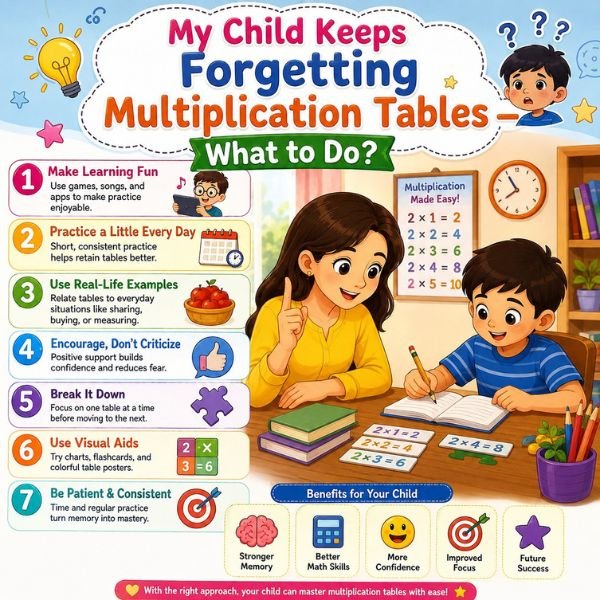
You spend a week teaching your child a multiplication table, they finally get it right and
then a few days later, it is gone. This is one of the most frustrating experiences for parents,
and it is far more common than most people realise.
In this post, we will explain why children forget tables even after learning them, and give you
a practical plan to make the memory stick for good.
Why Do Kids Forget Multiplication Tables So Quickly?
Forgetting is not a sign that your child is weak at math. It usually happens because of how
the table was learned in the first place.
Common Reasons Tables Don’t Stick
- Learned Too Fast, Too Many at Once
Cramming 2 or 3 tables in a single week overloads short-term memory. Without enough repetition, the brain simply does not have time to move the facts into long-term memory.
- Only Memorised in Order
If a child can only recite a table from the beginning (2, 4, 6, 8…) but freezes when asked ‘7 × 6’ directly, the table was memorised as a sequence, not as individual facts. - No Regular Revision
Once a table feels ‘done’, many parents move on completely. Without occasional revisits, even well-learned tables fade within a few weeks. - Learned Only Through Repetition, Without Understanding
Tables memorised by rote, without understanding that multiplication is repeated addition, aremuch easier to forget than tables the child truly understands.
How to Help Your Child Remember Tables — Step by Step
Step 1: Slow Down and Master One Table Fully
Stick to one table until your child can answer any question from it instantly and in random
order, not just in sequence. This may take longer, but it lasts much longer too.
Step 2: Use Spaced Repetition
Revisit tables already ‘learned’ every few days, even briefly. A 2-minute review of last week’s
table prevents it from fading, and takes far less effort than relearning it from scratch.
Step 3: Test in Random Order Only
Never test a table only from the start. Ask random questions like ‘6 × 4’ or ‘9 × 3’ to confirm
true memorisation rather than sequence memory.
Step 4: Use Flashcards for Daily Quick Drills
Flashcards are one of the best tools for spaced repetition. Shuffle them daily and practice for
just 3 to 5 minutes — short, frequent sessions beat long infrequent ones.
Step 5: Connect Tables to Understanding
Regularly remind your child that 6 × 4 means ‘6 groups of 4’ or ‘4 + 4 + 4 + 4 + 4 + 4’. Facts
that are understood, not just memorised, are far more resistant to forgetting.
Step 6: Revisit Old Tables Weekly
Once your child moves to a new table, keep a rotating 5-minute weekly revision of all
previously learned tables so nothing gets left behind. your child moves to a new table, keep a rotating 5-minute
A Simple Weekly Revision Routine
● Monday to Friday: 5 minutes on the new table being learned
● Every day: 2 minutes randomly testing 1-2 older tables
● Weekend: quick flashcard round covering all tables learned so far
Common Mistakes Parents Make
● Moving to a new table too soon, before the current one is fully solid
● Never revisiting older tables once they seem ‘done’
● Only testing tables in sequential order
● Getting frustrated, which increases math anxiety and makes forgetting worse
When Should This Improve?
In most Indian school curricula (CBSE and ICSE),children continue practising multiplication
tables through Grade 2 and Grade 3, around age 7 to 9. With consistent spaced repetition,
most children show noticeably stronger recall within 3 to 4 weeks.
FAQ
This usually happens because tables were learned quickly without enough spaced repetition,
or memorised only in sequence rather than as individual facts.
Use spaced repetition — briefly revisit older tables every few days — and always test in
random order, not just from the beginning of the table.
Yes, this is very common. Memory needs repeated, spaced practice to move from short-term
to long-term recall.
Just 5 minutes of focused daily practice, combined with a quick 2-minute review of older
tables, is usually enough for steady improvement.
Always test randomly. Testing only in order can hide the fact that a child has memorised a
sequence rather than the actual multiplication facts.