
Blog
How to Teach Division to Kids in a Simple Way

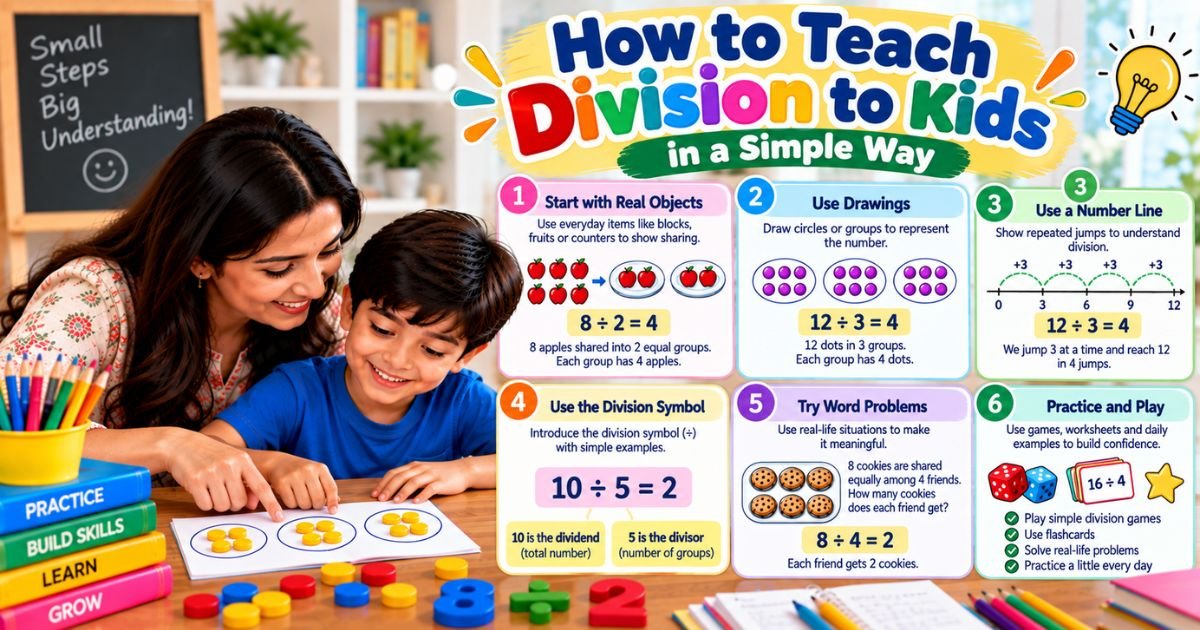
Division is usually the last of the four basic math operations children learn, and it can feel intimidating at first — both for kids and parents. But division is really just ‘fair sharing’ in disguise, and once explained the right way, it becomes very manageable.
In this guide, we will show you a simple, step-by-step approach to teach division to your child at home.
Why Division Feels Harder Than Other Operations
Division depends on addition, subtraction, and multiplication all being fairly solid first. It also introduces new ideas like sharing equally and remainders, which take a little more time to click.
💡 Division is best understood as ‘sharing equally’ — once your child sees it that way, the concept feels much more natural.
How to Teach Division — Step by Step
Step 1: Start With Sharing, Not Numbers
Give your child 12 candies and ask them to share equally between 3 friends. Let them physically distribute the candies one by one. Count how many each friend gets — that is division in action, no numbers needed yet.
Step 2: Introduce Grouping
Show the same idea from another angle: if you have 12 candies and want to make groups of 4, how many groups can you make? This ‘grouping’ view of division complements the ‘sharing’ view.
Step 3: Connect Division to Multiplication
Once your child knows a few multiplication tables, show the link: if 3 × 4 = 12, then 12 ÷ 3 = 4 and 12 ÷ 4 = 3. This connection makes division facts far easier to recall.
Step 4: Use Division as Repeated Subtraction
Show that 12 ÷ 4 can also be solved by repeatedly subtracting 4 from 12 and counting how many times you subtract: 12 − 4 = 8, 8 − 4 = 4, 4 − 4 = 0 — that is 3 times, so 12 ÷ 4 = 3.
Step 5: Introduce the Division Symbol and Written Form
Once your child understands the concept through objects and repeated subtraction, introduce the ÷ symbol and simple written division problems, starting with numbers that divide evenly.
Step 6: Practice Daily for 5 to 10 Minutes
As with other operations, short daily practice — sharing objects, a few written problems, or a quick multiplication-division fact check — builds confidence steadily.
Fun Activities to Teach Division at Home
- Sharing Snacks — divide fruits, biscuits, or sweets equally among family members
- Division Story Time — ‘We have 10 balloons for 2 kids, how many balloons each?’
- Egg Carton Division — use an egg carton to divide small objects into equal rows
- Division Bingo — call out a division fact and let your child mark the matching answer
- Division Worksheets — structured written practice once the concept is clear
Common Mistakes Parents Make
- Introducing division before multiplication tables are reasonably solid
- Jumping straight to written division without the sharing or grouping stage
- Introducing remainders too early, before even division is comfortable
- Expecting division to click as fast as addition, when it naturally needs more time
When Do Kids Learn Division?
In most Indian school curricula (CBSE and ICSE), division is introduced in Grade 2, typically around age 7 to 8, right after multiplication, starting with simple sharing and grouping before moving into written division.
FAQ
Start with sharing real objects equally among friends or family, before introducing any numbers or symbols. This builds the concept naturally.
Division and multiplication are inverse operations. If 3 × 4 = 12, then 12 ÷ 3 = 4 and 12 ÷ 4 = 3 automatically follow.
Most children are introduced to division in Grade 2, around age 7 to 8, shortly after learning multiplication.
No, multiplication should come first. Division builds directly on multiplication facts, so a shaky multiplication foundation makes division harder.
Use real objects for equal sharing, connect it to multiplication facts your child already knows, and practice for 5 to 10 minutes daily.