
Blog
How to Teach Counting to Kids at Home — Step by Step Guide

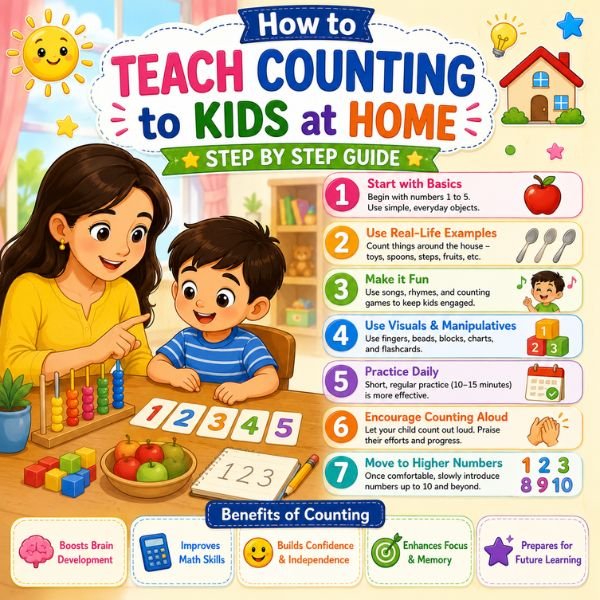
Teaching counting to young kids does not have to be hard. With the right steps and a little daily practice, your child can learn numbers from 1 to 10 and beyond — right at home.
This guide gives you simple, proven methods that parents and teachers use every day. No special tools needed — just patience, consistency, and the right activities.
Why is Counting Important for Kids?
Counting is the foundation of all math. Before a child can add, subtract, or understand numbers, they need to know how to count.
When kids learn counting early, they develop:
- Number recognition — knowing what each number looks like
- Number sequence — understanding that numbers come in a fixed order
- One-to-one correspondence — counting one object for each number said
- Basic math confidence — a strong start that helps them in school
Step 1 — Start With Numbers 1 to 5
Do not rush. Begin with just 1 to 5.
Use fingers — they are the most natural counting tool for any child. Count fingers together every morning. Say the numbers out loud clearly and slowly.
Try this: Hold up one finger and say “one.” Hold up two and say “two.” Repeat every day for one week before moving further.
Once your child can count to 5 without help, move to 1 to 10.
Step 2 — Count Everyday Objects Around the House
Make counting part of daily life. There is no need for a classroom setup.
Examples to try at home:
- Count apples in the fruit basket
- Count stairs as you climb them
- Count spoons while setting the table
- Count toys before putting them away
This teaches kids that numbers are real and useful — not just something on paper.
Step 3 — Use Rhymes and Songs
Young children learn faster through songs and rhythm. Counting rhymes make numbers stick in their memory.
Popular counting songs like One Two Buckle My Shoe or Five Little Ducks repeat numbers in a fun way. Play these during playtime or before bed.
Even simple counting chants — “1, 2, 3, 4, 5… again!” — repeated throughout the day can speed up learning.
Step 4 — Introduce Counting Worksheets
Once your child is comfortable counting verbally, introduce written practice.
Worksheets help kids:
- See numbers in written form
- Write numbers on their own
- Connect objects to numbers visually
Start with a simple Counting 1 to 10 Worksheet. Ask your child to count the objects shown and write the number. Do one worksheet per day — just 5 to 10 minutes is enough.
📥 Download Free Counting 1 to 10 Worksheet →
When they are ready, move to the Counting 1 to 20 Worksheet for the next level.
📥 Download Free Counting 1 to 20 Worksheet →
Step 5 — Play Number Games
Games keep kids engaged and make learning feel like fun, not work.
Easy games you can play at home:
- Number Hopscotch — draw numbers on the floor, call a number, and ask them to jump on it
- Count and Clap — clap hands while counting together
- Number Hunt — write numbers on paper, scatter them around the room, and ask your child to find number 3, then 7, and so on
- Object Sorting — give them 10 blocks and ask them to put 4 in one box and 6 in another
These games teach counting in a natural, enjoyable way.
Step 6 — Practise Every Day for 5 to 10 Minutes
Consistency matters more than long sessions. A short 5-minute counting activity every day is far better than a 1-hour session once a week.
Build a simple routine:
- Morning: Count objects during breakfast
- Afternoon: One worksheet page
- Evening: A counting song or game
Within 3 to 4 weeks, most children show clear improvement in number recognition and counting confidence.
Common Mistakes Parents Make
Avoid these when teaching counting:
- Rushing to higher numbers too fast — master 1 to 10 before going to 20
- Only using worksheets — balance written work with hands-on activities
- Getting frustrated — every child learns at their own pace; keep it positive
- Skipping daily practice — short, regular sessions work much better than occasional long ones
When Should Kids Start Learning to Count?
Most children can begin basic counting between age 2 and 3. By age 4 to 5, they should be able to count to 10 or 20 with confidence.
If your child is in nursery or kindergarten and still struggling, that is completely normal. Just follow the steps above — consistent practice always helps.
📥 Free Worksheets for Counting Practice
Use these free printable worksheets to support your child’s counting at home:
Simply download, print, and use daily. No login required.
Frequently Asked Questions
Repetition is the key. Sing counting songs daily and count objects out loud together. When children hear and use numbers in real situations, they remember them better. Keep sessions short and fun — never make it feel like a test.
Most children can count to 10 by age 4 to 5. However, every child develops at their own pace. If your child is 5 or 6 and still working on it, daily practice with simple counting activities and worksheets will help them get there.
Both work best together. Activities (games, songs, counting objects) build number sense. Worksheets build writing skills and visual recognition. Use both in your daily routine for the best results.