
Blog
Punctuation for Kids What It Is and Why It Matters

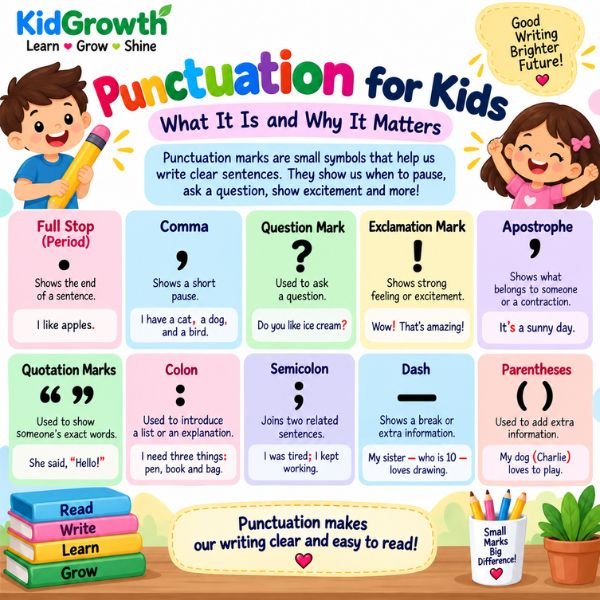
Punctuation marks might look like small dots and squiggles, but they play a big role in helping readers understand what we write. Teaching punctuation early helps children write clearer, more meaningful sentences.
In this post, we explain the basic punctuation marks kids learn first and why each one matters.
What is Punctuation?
Punctuation refers to the marks we use in writing to show pauses, stops, questions, and other signals that help a reader understand a sentence correctly.
The Basic Punctuation Marks Kids Learn First
Full Stop ( . )
A full stop marks the end of a complete sentence that is making a statement. It tells the reader: ‘This thought is finished; take a full pause here.’
Example: ‘The cat is sleeping.’
Question Mark ( ? )
A question mark is used at the end of a sentence that asks something. It signals to the reader that a question is being asked, often changing how the sentence is read aloud.
Example: ‘Where is the cat?’
Exclamation Mark (!)
An exclamation mark shows strong feeling excitement, surprise, or emphasis. It tells the reader to notice extra energy in the sentence.
Example: “The cat jumped so high!”
Comma (,)
A comma shows a short pause within a sentence, often used to separate items in a list or parts of a longer sentence.
Example: “I have a cat, a dog, and a bird.”
How to Teach Punctuation to a Child Step by Step
Step 1: Start With the Full Stop
Introduce the full stop first, since it is the most common and simplest punctuation mark. Read simple sentences together and pause fully at each full stop.
Step 2: Introduce the Question Mark Through Real Questions
Ask your child real questions and show how they end with a question mark when written down: ‘What is your name?’
Step 3: Add the Exclamation Mark With Expression
Read exclamation sentences with extra excitement in your voice, showing how the punctuation mark matches the feeling behind the words.
Step 4: Practice Sorting Sentences by Punctuation
Give your child a mix of statement, question, and exclamation sentences (without punctuation) and ask them to add the correct mark at the end.
Step 5: Introduce Commas Gradually
Commas are trickier, so introduce them later, starting with simple list examples like ‘apples, bananas, and oranges’.
Fun Ways to Practice Punctuation at Home
- Punctuation Sorting — sort sentence cards by which punctuation mark they need
- Expression Reading — read sentences aloud, changing your tone for questions and exclamations
- Fix the Sentence — find and correct missing punctuation in simple sentences
- Storytime Spotting — pause while reading and point out punctuation marks on the page
- Punctuation Worksheets — structured written identification and usage practice
Common Mistakes Children Make
- Forgetting to add a full stop at the end of sentences
- Mixing up when to use a question mark versus a full stop
- Overusing exclamation marks in every sentence
- Struggling with comma placement in lists or longer sentences
When Do Kids Learn Punctuation?
In most Indian school curricula (CBSE and ICSE), basic punctuation marks like the full stop and question mark are typically introduced in Grade 1, around age 6, with commas and exclamation marks following shortly after.
Practice Resources
Support your child’s punctuation practice with these free printable worksheets:
- Punctuation Worksheet for Kids — Structured identification and usage practice
- Simple Sentences Worksheet — Practice punctuation within full sentences
FAQ
Punctuation refers to marks like full stops, question marks, and commas that help readers understand pauses, stops, and questions in writing.
Start with the full stop, then introduce the question mark through real questions, and add exclamation marks and commas gradually with simple examples.
The full stop and question mark are usually taught first, since they are the most common, followed by the exclamation mark and comma.
Basic punctuation like full stops and question marks are typically introduced in Grade 1, around age 6, in most Indian school curricula.
Punctuation helps readers understand the meaning, tone, and pauses in a sentence correctly, making writing clearer and easier to follow.