
Blog
My Child Cannot Spell Why It Happens and How to Help

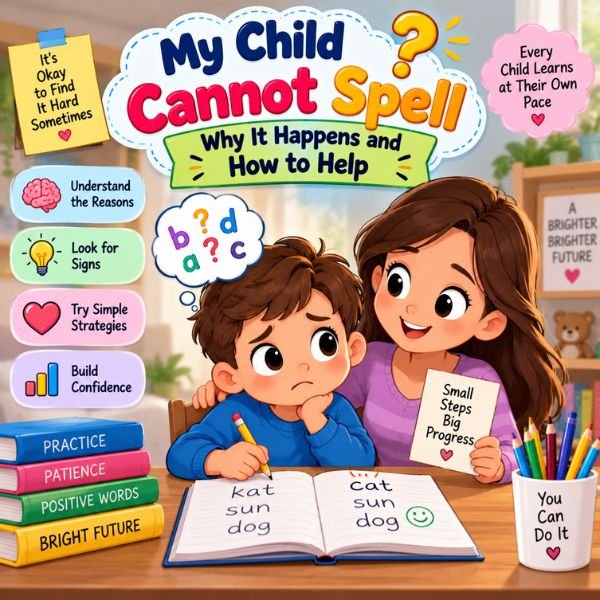
Frequent spelling mistakes, even on words your child seemed to know last week, can be frustrating for both of you. The good news is that spelling struggles are extremely common at this age and almost always improve with the right kind of practice.
In this post, we explain why spelling problems happen and share practical steps you can take at home to help.
Why Do Kids Struggle With Spelling?
Spelling combines several skills at once — phonics knowledge, visual memory, and motor recall of letter sequences. If any of these is still developing, spelling mistakes are a natural result, not a sign of a bigger problem.
Common Reasons Behind Spelling Difficulty
1. Weak Phonics Foundation
Spelling relies heavily on knowing letter sounds. If phonics knowledge is shaky, spelling words correctly becomes much harder, since sounding out each part is the core spelling strategy.
2. Words That Don’t Follow Regular Rules
English has many irregular words (like ‘said’ or ‘was’) that don’t follow standard phonics rules, and these naturally cause more spelling errors until memorised separately.
3. Limited Visual Memory Practice
Some words need to be visually memorised rather than sounded out. Without enough repeated visual exposure, these words are harder to spell correctly from memory.
4. Rushing Through Writing
Children who write quickly without carefully thinking through each letter often make more careless spelling errors, even on words they generally know.
5. Too Many New Words at Once
Introducing too many spelling words in a short period overwhelms memory, making it harder for any single word to be retained properly.
How to Help Your Child Spell Better: Step by Step
Step 1: Strengthen the Phonics Foundation
If phonics knowledge is shaky, spend extra time on letter sounds and blending before pushing further spelling practice — this is the most common root cause.
Step 2: Use the Look, Cover, Write, Check Method
This active recall technique — looking at a word, covering it, writing from memory, then checking — is one of the most effective spelling strategies for young children.
Step 3: Slow Down Writing Practice
Encourage your child to say each part of a word slowly while writing it, rather than rushing. This reduces careless mistakes significantly.
Step 4: Focus on a Small Number of Words at a Time
Stick to 5 to 8 words per week rather than long lists, giving each word enough repeated, focused attention to be properly retained.
Step 5: Revisit Previously Learned Words
Spelling knowledge fades without review. Set aside a few minutes weekly to revisit older word lists alongside new ones.
Common Mistakes Parents Make
- Assuming spelling mistakes mean a child is simply not trying
- Skipping the phonics connection when teaching new spelling words
- Giving too many new words at once
- Not revisiting older word lists once a spelling test is over
When Should Spelling Difficulty Improve?
In most Indian school curricula (CBSE and ICSE), spelling is a developing skill throughout Grade 1 and Grade 2, roughly ages 6 to 8, and gradual, steady improvement with consistent practice is expected during this period.
Practice Resources
Support your child’s spelling practice with these free printable worksheets:
- Correct the Spelling Worksheet — Builds error-spotting skills
- Spelling Words Grade 1 Worksheet — Structured weekly spelling practice
FAQ
This usually points to a specific gap often a weak phonics foundation, insufficient visual memory practice, or too many new words introduced at once rather than a lack of effort.
Strengthen phonics first, use the Look, Cover, Write, Check method, slow down writing practice, and focus on a small number of words at a time.
Yes, spelling mistakes are very common in Grade 1 and Grade 2, as children are still developing phonics knowledge and visual word memory.
This can happen if a word was not reviewed again after the initial practice. Spelling knowledge fades without regular revisiting of previously learned words.
Most children show steady spelling improvement through Grade 1 and Grade 2, roughly age 6 to 8, with consistent, focused practice.