
Blog
At What Age Should Kids Learn to Write Alphabets — Full Guide

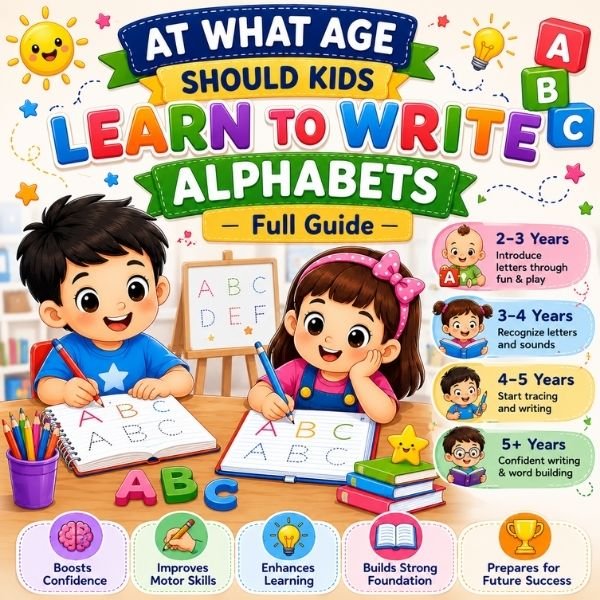
One of the most common questions from parents of young children is: at what age should kids learn to write alphabets? While every child develops at their own pace, there are clear general milestones to guide you.
In this guide, we will walk through the typical age ranges for alphabet writing readiness and what to look for at each stage.
General Age Guide for Alphabet Writing
| Age | Stage | What to Expect |
| 2 to 3 years | Pre-writing | Scribbling, holding crayons, basic hand control |
| 3 to 4 years | Early tracing | Tracing large shapes and lines, some letter recognition |
| 4 to 5 years | Guided writing | Tracing letters with dotted lines, starting name writing |
| 5 to 6 years | Independent writing | Writing most letters without guides, growing confidence |
Signs Your Child is Ready to Start Writing Letters
- Can hold a crayon or pencil with a reasonably steady grip
- Enjoys scribbling, drawing, or colouring activities
- Can trace simple shapes like circles and straight lines
- Shows interest in letters — pointing them out or asking what they say
- Can sit and focus on a simple activity for a few minutes at a time
Stage-by-Stage Guide to Alphabet Writing Readiness
Age 2 to 3: Pre-Writing Stage
At this age, children are not ready for letter writing yet. Focus instead on scribbling, holding crayons, and simple shape drawing — these build the hand strength and control needed later.
Age 3 to 4: Early Tracing Stage
Children can start tracing large shapes, lines, and curves. Some letter recognition (recognising letters, especially in their own name) can begin, but formal letter writing is still early for most children at this stage.
Age 4 to 5: Guided Writing Stage
This is typically when formal alphabet writing begins in most Indian preschools. Children start tracing letters with dotted-line guides and often begin with writing their own name.
Age 5 to 6: Independent Writing Stage
By this age, most children can write letters without tracing guides, though handwriting may still be uneven. Confidence and consistency continue to develop through Grade 1.
What If My Child is Not Ready Yet?
If your child is not showing readiness signs by the expected age, there is usually no need to worry. Continue with fine motor activities like playdough, colouring, and simple tracing, and reintroduce letter writing gently every few weeks. Most children catch up naturally with patient, low-pressure practice.
Common Mistakes Parents Make
- Starting formal letter writing before basic fine motor skills are ready
- Comparing a child’s writing readiness to siblings or classmates
- Skipping the tracing and pre-writing stages entirely
- Creating pressure or frustration around an activity that should feel playful at this age
What Indian School Curricula Expect
In most Indian school curricula (CBSE and ICSE), formal alphabet writing typically begins around age 4 to 5 in nursery or LKG, with children expected to write most letters independently by UKG or the start of Grade 1, around age 5 to 6.
Practice Resources
Support your child’s writing readiness with these free printable resources:
- Alphabet Tracing A to Z — Dotted-line practice for guided writing
- Pre-Writing Tracing Worksheet — Builds foundational shapes and lines before letters
FAQ
Most children begin guided letter writing around age 4 to 5, and can write independently by age 5 to 6, though every child develops at their own pace.
Look for signs like a steady pencil grip, interest in letters, and the ability to trace simple shapes — these usually indicate readiness for formal writing practice.
Focus on pre-writing activities like scribbling, colouring, and tracing simple shapes and lines to build the fine motor control needed for letters.
Yes, this is common. Continue fine motor and tracing activities, and reintroduce letter writing gently every few weeks — most children catch up naturally.
Most children can write most letters without tracing guides by age 5 to 6, typically around UKG or the start of Grade 1.