
Blog
Alphabetical Order — How to Teach It to Kids Easily

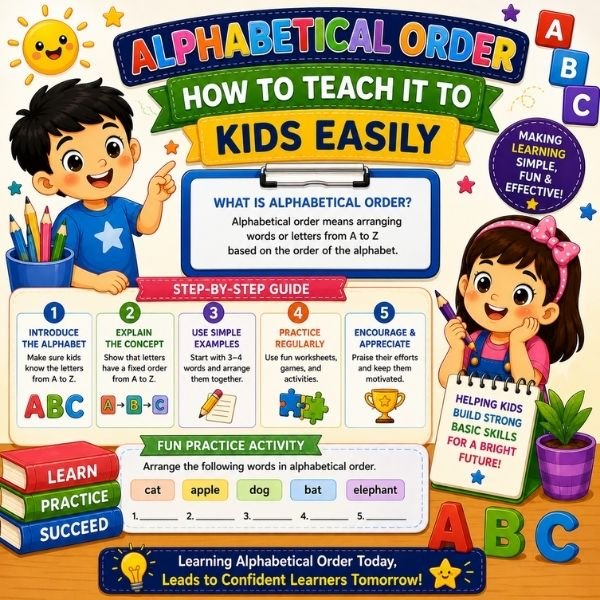
Once your child knows all 26 letters, the next useful skill is understanding alphabetical order — the fixed sequence A to Z that organises everything from dictionaries to class attendance lists.
In this post, we will explain what alphabetical order means and share simple, effective ways to teach it to your child at home.
What is Alphabetical Order?
Alphabetical order means arranging letters or words in the same sequence as they appear in the alphabet, from A to Z.
In simple words: just like numbers have a fixed order (1, 2, 3…), letters also have a fixed order (A, B, C…), and alphabetical order means following that exact sequence.
Why is Alphabetical Order Important?
- Used in dictionaries, encyclopedias, and phone contact lists
- Helps with organising files, books, and school class lists
- Builds sequencing skills that support broader logical thinking
- A foundational skill needed for using reference books independently
How to Teach Alphabetical Order — Step by Step
Step 1: Make Sure the Full Alphabet is Solid
Before alphabetical order, your child should be able to recite A to Z confidently and recognise each letter individually. This foundation makes ordering much easier to grasp.
Step 2: Sing the Alphabet Song While Pointing
Sing the ABC song together while pointing to each letter on a chart. This reinforces both the sound and the fixed sequence at the same time.
Step 3: Practice With Letter Cards
Give your child a small set of letter cards, mixed up, and ask them to arrange them back in the correct A to Z order. Start with just 5 to 6 letters before moving to the full alphabet.
Step 4: Introduce ‘What Comes Before and After’
Ask questions like: ‘What letter comes after C?’ or ‘What letter comes before M?’ This builds flexible understanding of the sequence, not just memorised recitation.
Step 5: Order Simple Word Lists
Once single letters are solid, move to ordering simple words by their first letter—like Apple, Ball, Cat—so your child can compare just the first letter of each word.
Step 6: Introduce Dictionary Skills
Show your child a simple children’s dictionary and how words are arranged alphabetically. Let them look up a few familiar words to see alphabetical order in real use.
Fun Ways to Practice Alphabetical Order at Home
- Alphabet Card Race — mix up letter cards and time how fast your child can reorder them
- Missing Letter Game — remove a few letters from a sequence and ask your child to fill them in
- Name Sorting — write family members’ names and ask your child to order them alphabetically
- Bookshelf Sorting — arrange a small stack of books alphabetically by title
- Alphabetical Order Worksheets — structured written practice
Common Mistakes Children Make
- Confusing letter order with letter sound similarity
- Trying to memorise word order instead of understanding the first-letter comparison rule
- Skipping practice with ‘before and after’ questions, relying only on full recitation
- Attempting word ordering before individual letter order is solid
When Do Kids Learn Alphabetical Order?
In most Indian school curricula (CBSE and ICSE), alphabetical order is typically introduced in Grade 1, around age 6 to 7, once the alphabet itself is fully learned and recognised.
Practice Resources
- Alphabetical Order Worksheet — Structured A to Z sequencing practice
- Missing Letters A to Z Worksheet — Fill-in-the-blank sequence practice
FAQ
Alphabetical order means arranging letters or words in the same fixed sequence as the alphabet, from A to Z.
Start with solid letter recognition, then practice reordering mixed-up letter cards, ask ‘before and after’ questions, and gradually move to ordering simple words by their first letter.
Most children learn alphabetical order in Grade 1, around age 6 to 7, after the full alphabet is well known.
Compare the first letter of each word first. The word whose first letter comes earlier in the alphabet is placed first.
It is used in dictionaries, class lists, and everyday organising, and it builds broader sequencing and logical thinking skills.