
Blog
My Child Confuses b d p q — How to Fix Letter Reversal in Kids

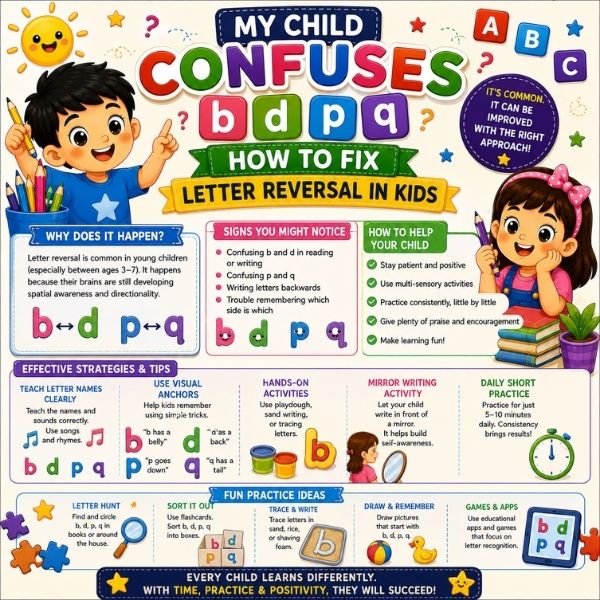
If your child regularly writes ‘b’ as ‘d’, or mixes up ‘p’ and ‘q’, you have probably wondered if something is wrong. Take a breath — this is one of the most common and completely normal patterns in early childhood writing.
In this post, we will explain why letter reversal happens, when it is expected to resolve on its own, and simple ways to help your child at home.
Is Letter Reversal Normal?
Yes, very much so. Letters like b, d, p, and q are mirror images of each other, and young children’s brains have not yet fully mastered the concept of left-right orientation in symbols. This is a normal part of learning to read and write, not a sign of a problem.
Why Do Kids Confuse b, d, p, and q?
These four letters share the exact same shape — a circle with a straight line — just rotated or flipped in different directions. Since young children are still developing the visual-spatial skill of distinguishing left from right, mixing these letters up is a very natural stage.
Is Letter Reversal a Sign of Dyslexia?
Occasional or common reversal of b, d, p, and q up to around age 7 is completely normal and not a sign of dyslexia on its own. Dyslexia involves a broader, more persistent pattern of reading and writing difficulties beyond just these letters. If reversal continues strongly well past age 7 alongside other reading struggles, it is worth discussing with your child’s teacher — but the letters alone are not a diagnosis
How to Help Your Child With Letter Reversal — Step by Step
Step 1: Don’t Make It a Big Deal
Avoid scolding or expressing worry when your child reverses a letter. Gently point it out and move on — anxiety around writing can make the habit worse, not better.
Step 2: Use a Memory Trick for b and d
Teach your child to make fists with both hands and stick out their thumbs — the left hand forms a ‘b’ shape and the right hand forms a ‘d’ shape, just like the word ‘bed’ when the hands are placed together. This physical trick helps many children remember the difference.
Step 4: Practice With Multi-Sensory Writing
Let your child trace the letters in sand, with playdough, or in the air with big arm movements. Multi-sensory practice reinforces the correct shape and direction more effectively than paper alone.
Step 5: Use Directional Arrows on Worksheets
Worksheets with small arrows showing the starting point and stroke direction for each letter help reinforce the correct formation every time your child practices.
Step 6: Be Patient and Consistent
Reversal usually fades naturally with continued reading and writing practice as your child’s brain matures. Consistent, low-pressure practice is far more effective than intensive correction.
When Should You Be More Concerned?
- Reversal continues strongly and consistently well past age 7 or 8
- It is combined with significant difficulty in reading, not just writing
- Your child also struggles noticeably with letter and sound recognition generally
- A teacher raises concerns separately about reading progress
If several of these apply, a conversation with your child’s teacher or a learning specialist is a reasonable next step — but for most children, reversal alone at this age is simply a normal developmental stage.
Common Mistakes Parents Make
- Reacting with visible worry or frustration when reversal happens
- Assuming reversal automatically means dyslexia
- Only practicing on paper, skipping multi-sensory methods
- Correcting too harshly instead of using gentle memory tricks
When Does Letter Reversal Usually Resolve?
In most Indian school curricula (CBSE and ICSE), letter reversal is very common through nursery and Grade 1, roughly age 4 to 7, and typically fades naturally by the end of Grade 1 or early Grade 2 with continued practice.
Practice Resources
Support your child’s letter recognition with these free printable worksheets:
- Alphabet Recognition Worksheet — Builds visual letter distinction
- Alphabet Writing Practice Worksheet — Reinforces correct letter formation
FAQ
Yes, confusing mirror-image letters like b, d, p, and q is very common in young children and is a normal part of early writing development.
Not on its own. Reversal is common up to around age 7. It is only worth discussing with a teacher if it persists strongly well beyond that age, alongside broader reading difficulties.
Try the ‘bed’ hand trick — making fists with thumbs out forms a ‘b’ with the left hand and a ‘d’ with the right, spelling ‘bed’ when placed together.
Most children naturally stop reversing letters like b, d, p, and q by the end of Grade 1 or early Grade 2, around age 6 to 7.
If reversal continues strongly at age 8, alongside other reading or writing difficulties, it is reasonable to discuss this with your child’s teacher for further guidance.