
Blog
Capital or Small Letters — Which to Teach Kids First

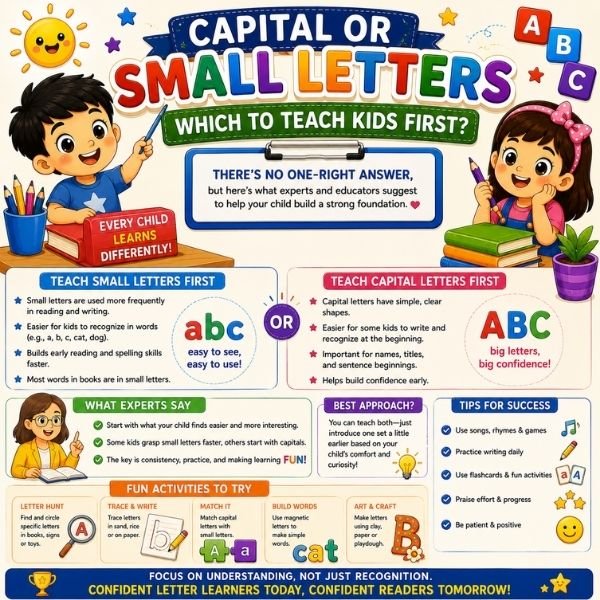
One of the most common questions parents ask when starting alphabet writing is whether to teach capital (uppercase) or small (lowercase) letters first. Both approaches have supporters, so let’s compare them clearly.
In this post, we break down the pros and cons of each approach and give you a clear recommendation based on how children actually learn.
Capital vs Small Letters — Quick Comparison
| Capital Letters | Small Letters |
| Simpler shapes — mostly straight lines and curves | More complex shapes, with ascenders and descenders |
| Easier for small hands to form accurately | Requires finer motor control |
| Used far less often in everyday reading and writing | Used about 90% of the time in real text |
| Traditionally taught first in many preschools | Taught after capitals are comfortable |
| Fewer letters cause confusion (like b/d, p/q) | Some letters look visually similar and cause reversal confusion |
Why Capital Letters Are Often Taught First
Capital letters are generally simpler in shape — most are made of straight lines and basic curves, which are easier for a young child’s developing hand to control. This makes early success more likely, building confidence before moving to trickier shapes.
Why Some Experts Recommend Small Letters First
Since about 90% of everyday reading and writing uses small letters, some experts argue starting there builds more practical, real-world skills faster. However, small letters are visually trickier, with several pairs like b/d and p/q that commonly confuse young children.
What Does Research and Practice Generally Suggest?
Most early-childhood educators recommend starting with capital letters, since their simpler shapes build fine motor confidence, and then transitioning to small letters once a child is comfortable holding a pencil and forming basic shapes.
A Practical Order to Follow at Home
Step 1: Start With Capital Letters
Begin with capital letters, focusing on simple straight-line letters first (like L, T, I) before moving to curved ones (like C, O, S).
Step 2: Introduce Letter Recognition for Both
Even while writing capitals, let your child see and recognise both capital and small versions of each letter — recognition can start earlier than writing.
Step 3: Move to Small Letters Once Capitals Feel Comfortable
Once your child can write most capital letters confidently, begin small letter writing, giving extra attention to commonly confused pairs like b/d and p/q.
Step 4: Practice Matching Capital and Small Letters
Use matching activities — connecting ‘A’ to ‘a’, ‘B’ to ‘b’ — to reinforce that each capital and small letter pair represents the same sound.
Common Mistakes Parents Make
- Teaching both capital and small letters for every letter at the same time, causing overload
- Rushing to small letters before capital letter formation is comfortable
- Not addressing commonly confused small letter pairs early enough
- Expecting perfect handwriting in both forms too soon
When Do Kids Learn Both Letter Forms?
In most Indian school curricula (CBSE and ICSE), children typically start with capital letter writing around age 4, in nursery or LKG, and move on to small letters by UKG or Grade 1, around age 5 to 6.
Practice Resources
Support your child’s letter writing with these free printable worksheets:
- Capital Letters Worksheet — Focused uppercase practice
- Small Letters Worksheet — Focused lowercase practice
- Capital and Small Letters Matching Worksheet — Reinforces the connection between both forms
FAQ
Most educators recommend starting with capital letters, since their simpler shapes are easier for young hands, before moving on to small letters.
Capital letters are mostly made of straight lines and simple curves, which are easier for developing fine motor skills to control accurately.
Most children move on to small letters around age 5 to 6, in UKG or Grade 1, once capital letter writing is comfortable.
Small letters like b, d, p, and q are visually similar mirror shapes, which commonly confuses young children still developing letter recognition.
It is usually easier for children to master capital letters first, then move to small letters, rather than learning both forms of every letter at the same time.