
Blog
Division With and Without Remainder — What Parents Should Know

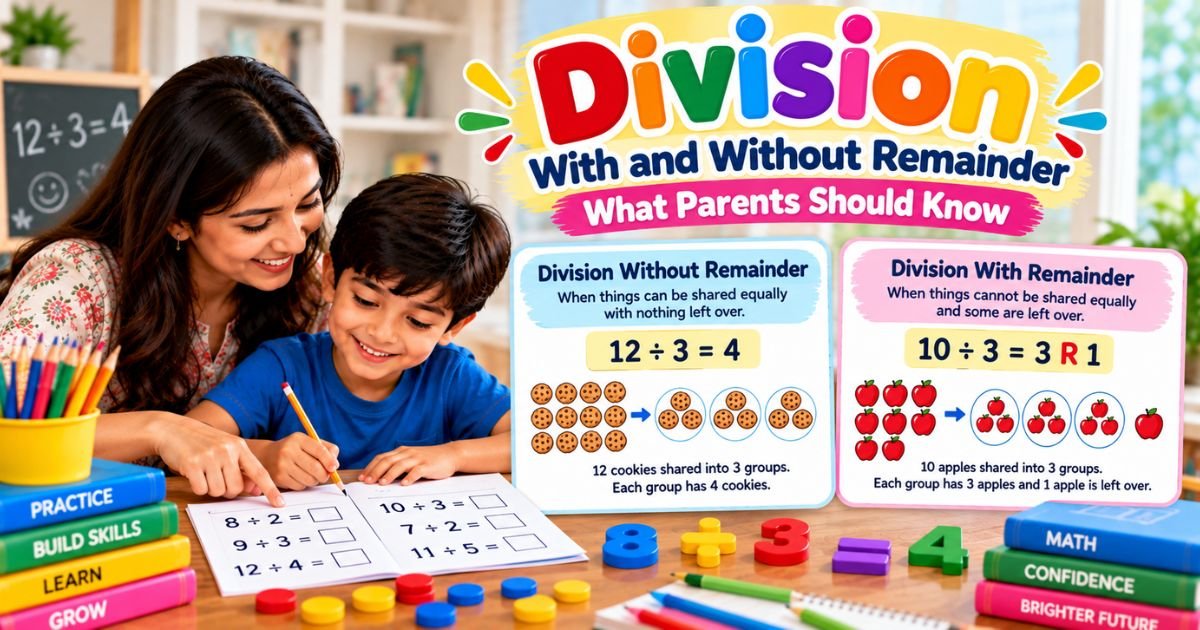
Once your child is comfortable with basic division, they will start seeing problems that do not divide evenly this is where ‘remainders’ come in. Many parents are unsure how to explain this clearly, so let’s break it down simply.
In this post, we will explain the difference between division with and without a remainder, and how to teach both to your child.
What is Division Without a Remainder?
Division without a remainder happens when a number splits perfectly evenly, with nothing left over.
Example: 12 ÷ 4 = 3. If you share 12 sweets equally among 4 friends, each friend gets exactly 3 sweets, and there are none left over.
What is a Remainder in Division?
A remainder is the amount left over when a number cannot be divided perfectly evenly.
Example: 13 ÷ 4. Sharing 13 sweets among 4 friends gives each friend 3 sweets, using up 12 sweets — but 1 sweet is left over, since it cannot be split fairly. That leftover 1 is the remainder. We write this as 13 ÷ 4 = 3 remainder 1.
How to Explain Remainders to a Child — Step by Step
Step 1: Master Division Without Remainder First
Never introduce remainders before your child is fully confident with even division. This foundation makes remainders far easier to understand later.
Step 2: Use Real Objects That Don’t Split Evenly
Give your child 13 buttons and ask them to share equally among 4 people. Let them physically distribute the buttons and discover that 1 is left over that cannot be split fairly.
Step 3: Introduce the Word ‘Remainder’
Once your child sees the leftover object, introduce the term: ‘This extra one that could not be shared is called the remainder.’
Step 4: Show the Written Form
Write it out together: 13 ÷ 4 = 3 remainder 1. Point out that the remainder is always smaller than the number being divided by (the divisor).
Step 5: Practice With Small Numbers
Start with simple problems where the remainder is easy to see and count, before moving to bigger numbers.
Division With Remainder vs Without Remainder
- Without remainder: the total splits perfectly evenly, nothing left over
- With remainder: some amount is left over that cannot be split equally
- Without remainder is taught first, and mastered before remainders are introduced
- The remainder must always be smaller than the divisor
Common Mistakes Children Make
- Writing a remainder that is bigger than the divisor (a sign the division was not fully worked out)
- Forgetting to write the remainder at all
- Confusing the remainder with the quotient (the main answer)
- Attempting remainder problems before basic division is solid
When Do Kids Learn Division With Remainders?
In most Indian school curricula (CBSE and ICSE), division without remainder is taught first in Grade 2, while division with remainders is usually introduced slightly later, around age 7 to 8, once basic division is well understood.
FAQ
A remainder is the amount left over when a number cannot be divided perfectly evenly among equal groups.
Use real objects like sweets or buttons. Share them equally and show your child the leftover piece that could not be split fairly — that is the remainder.
Yes, the remainder must always be smaller than the number you are dividing by. If it is not, the division has not been fully worked out.
Most children learn division with remainders shortly after mastering basic even division, typically around age 7 to 8 in Grade 2.
Always after. Division without a remainder should be fully mastered first, or remainders will feel like an entirely separate, confusing topic.