
Blog
Table of 2 to 10: Fun Ways to Help Kids Memorize

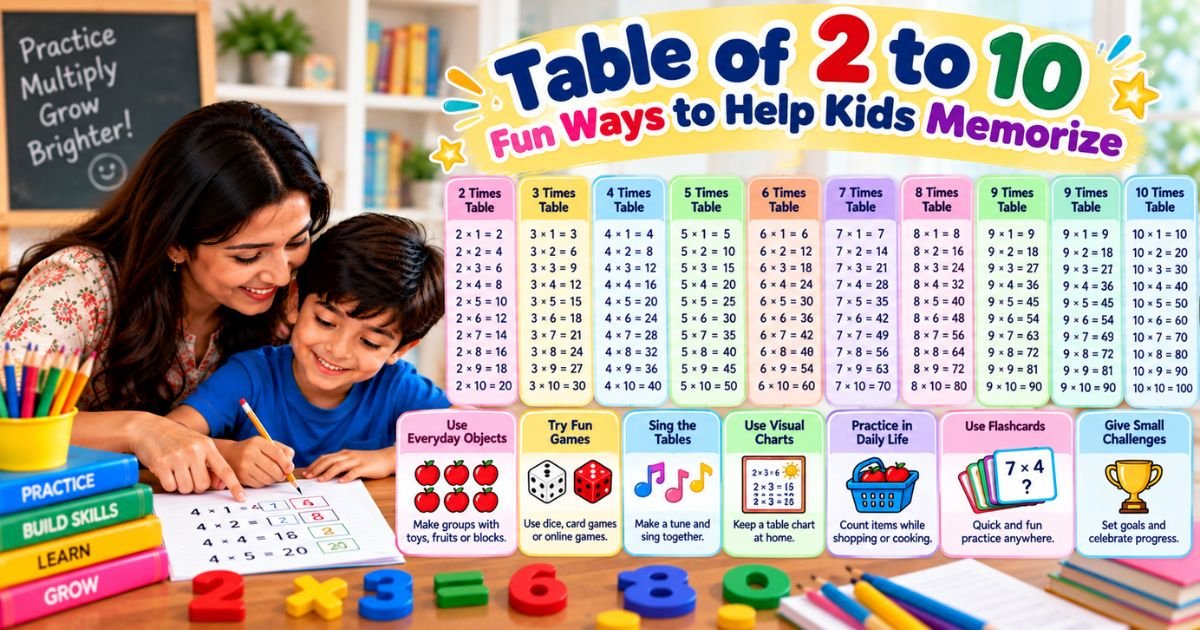
Learning tables from 2 to 10 does not have to mean boring repetition and flashcards alone. Children remember things far better when learning feels playful, so we have put together the best fun methods parents can use at home.
Here are 10 proven, enjoyable ways to help your child memorise multiplication tables from 2 to 10.
1. Multiplication Songs and Rhymes
Songs turn tables into rhythm and melody, which the brain remembers far more easily than plain numbers. Many free multiplication songs — in both English and Hindi — are available online and make a great car-ride or bath-time activity.
2. The Table of 9 Finger Trick
Hold up both hands. To find 9 × 6, fold down the 6th finger — the fingers before it show the tens digit, and the fingers after show the ones digit, giving 54. This trick works for the entire table of 9 and feels like magic to kids.
3. Skip Counting Connection
Since multiplication is repeated addition, connecting each table to skip counting makes it click faster. Table of 2 is skip counting by 2, table of 5 is skip counting by 5, and so on.
4. Times Tables Chart on the Wall
Put up a colourful multiplication chart from 2 to 10 somewhere your child sees daily — near the study table or fridge. Passive daily exposure reinforces memory without extra effort.
5. Multiplication Flashcard Games
Shuffle flashcards and turn practice into a quick game — first correct answer wins a point. Short, playful 5-minute sessions work better than long drilling sessions.
6. Roll the Dice Multiplication
Roll two dice and multiply the numbers shown. This turns tables into a quick, random-order game that naturally avoids the ‘memorised in sequence only’ trap.
7. Table of 10 — Add a Zero
This is the easiest table to make fun since the pattern is instant: any number times 10 just adds a zero. Great confidence booster to start with.
8. Skip and Clap Games
Say the table together, clapping on each answer: ‘table of 3… 3, CLAP, 6, CLAP, 9, CLAP…’ Rhythm and movement help numbers stick in memory.
9. Real-Life Multiplication Hunts
Ask your child to find multiplication in daily life — like counting wheels on 4 cars (4 × 4) or eggs in 3 trays of a dozen. This shows tables are useful, not just something to memorise.
10. Multiplication Bingo
Create a simple bingo grid with answers to a table. Call out questions like ‘7 × 3’ and let your child mark the matching answer. This is one of the most fun ways to test recall without it feeling like a test.
Quick Reference: Best Trick for Each Table
- Table of 2 — doubling
- Table of 3 — skip counting rhythm
- Table of 4 — double the table of 2
- Table of 5 — clock face, ends in 0 or 5
- Table of 6 — double the table of 3
- Table of 8 — double the table of 4
- Table of 9 — finger trick
- Table of 10 — add a zero
Common Mistakes Parents Make
- Making every practice session feel like a serious test
- Sticking to only one method (usually repetition) for every table
- Not connecting tables to skip counting your child already knows
- Skipping playful revision once a table seems ‘learned’
When Do Kids Learn Tables 2 to 10?
In most Indian school curricula (CBSE and ICSE), children learn tables 2 to 10 gradually across Grade 2 and Grade 3, typically between age 7 and 9, building from the easier patterns toward the harder ones.
FAQ
Songs, the finger trick for table of 9, flashcard games, dice games, and real-life multiplication
hunts are all engaging ways that work better than plain repetition alone.
Use the finger trick — fold down the finger matching the number being multiplied by 9, and
the fingers on either side show the tens and ones digits of the answer.
Turn practice into short games — dice rolls, flashcard races, or bingo — instead of long
repetitive drilling sessions.
Most children learn tables 2 to 10 gradually across Grade 2 and Grade 3, typically between
age 7 and 9.
Yes, rhythm and melody help the brain retain number patterns more easily than plain
memorisation, making songs a genuinely useful learning tool.