
Blog
How to Teach Subtraction to Grade 1 Kids Step by Step

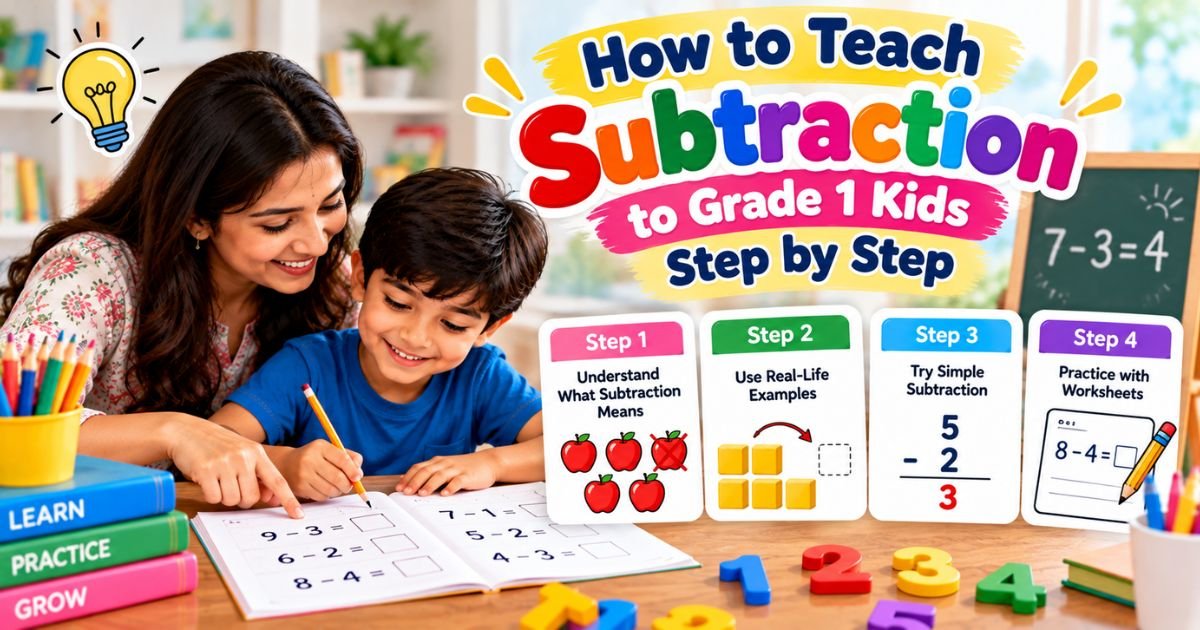
find it trickier than addition, but with the right approach at home, it becomes just as easy.
In this guide, we will explain what subtraction really means, and give you a simple step-by-step plan to teach it to your child — no classroom, no complicated methods, just daily practice that works.
Why is Subtraction Important for Kids?
Subtraction is one of the four basic math operations, and it builds directly on counting and number sense. Once a child understands subtraction, they can:
- Solve everyday problems — like how many chocolates are left
- Understand the opposite of addition, which strengthens overall number sense
- Build a foundation for later topics like division and word problems
- Gain confidence to handle school tests and homework independently
What is Subtraction? A Simple Explanation
Subtraction means taking away one number from another to find out what is left.
In simple words: if you start with a group of objects and remove some of them, subtraction tells you how many remain.
Example: If a child has 5 candies and eats 2, subtraction tells us 5 − 2 = 3 candies are left.
💡 Quick rule: the bigger number always comes first when we subtract two whole numbers up to 10 or 20 at this stage.
How to Teach Subtraction Step by Step
Step 1: Start With the ‘Taking Away’ Idea
Before numbers on paper, use real objects. Give your child 5 blocks, ask them to remove 2, and count what is left. Say it out loud: ‘5 take away 2 leaves 3.’ Repeat with different small quantities.
Step 2: Use a Number Line
Draw a number line from 0 to 10. To solve 7 − 3, ask your child to start at 7 and hop backward 3 steps. Where they land is the answer. This visual method makes subtraction easy to picture.
Step 3: Connect Subtraction to Addition
Show your child that subtraction and addition are related. If 3 + 4 = 7, then 7 − 4 = 3 and 7 − 3 = 4. Understanding this link helps children check their subtraction answers using addition.
Step 4: Practice With Fingers and Small Numbers
Fingers work well for subtraction up to 10. Hold up 8 fingers, fold down 3, and count what remains. This hands-on method builds accuracy before moving to written work.
Step 5: Introduce Written Subtraction Worksheets
Once your child is confident subtracting verbally and with objects, move to writing. Start with simple subtraction worksheets without borrowing — just single-digit numbers on paper. Do one small worksheet page daily, 5 to 10 minutes is enough.
Step 6: Practice Daily for 5 to 10 Minutes
Consistency beats long sessions. A short daily habit — one worksheet page, a few number-line problems, or a quick object-based question — builds strong subtraction skills within 3 to 4 weeks.
Fun Activities to Practice Subtraction at Home
1. Take-Away Snack Game
Give your child a small bowl of snacks like raisins or peanuts. Ask them to eat a few and count how many are left. Repeat with different starting numbers.
2. Number Line Hopscotch
Draw a number line from 0 to 10 on the floor with chalk. Call out a subtraction problem and ask your child to physically hop backward to find the answer.
3. Subtraction Story Time
Make up simple stories: ‘There were 6 birds on a tree, 2 flew away. How many are left?’ Stories make subtraction feel real instead of abstract.
4. Roll and Subtract
Roll two dice, subtract the smaller number from the bigger one, and say the answer out loud. This is a quick, playful daily drill.
5. Subtraction Worksheets
Structured worksheets help children get comfortable writing subtraction problems and reinforce what they practise with objects and games.
Common Mistakes Parents Should Avoid
- Jumping straight to written subtraction — always start with objects and visuals first
- Introducing borrowing too early — master simple subtraction without borrowing first
- Only doing worksheets — balance written practice with hands-on games
- Rushing the pace — every child learns subtraction at a different speed, so stay patient
When Do Kids Learn Subtraction?
In most Indian school curricula (CBSE and ICSE), subtraction is introduced in Grade 1, typically around age 6 to 7, right after basic counting and addition. By the end of Grade 1, children are usually expected to:
- Subtract numbers up to 20 without borrowing
- Understand subtraction using objects and number lines
- Solve simple one-step subtraction word problems
- Recognise the relationship between addition and subtraction
Some children pick up subtraction quickly right after addition, while others need a few extra weeks of hands-on practice before it clicks — both are completely normal.
FAQ
Q: What is an easy way to explain subtraction to a child?
Tell your child that subtraction means taking some objects away and counting what is left. Use real objects like blocks or snacks to show this before moving to numbers on paper.
Q: How do I teach my child subtraction at home?
Start with taking-away activities using real objects, then move to a number line, connect it to addition, and finally introduce simple written worksheets. Practice for 5 to 10 minutes daily.
Q: What is the best way to teach subtraction without borrowing?
Use single-digit numbers where the top number is always bigger, and let your child practise with objects and number lines before writing the problems down.
Q: At what age do kids learn subtraction?
Most children learn basic subtraction in Grade 1, around age 6 to 7, right after they are comfortable with counting and addition.
Q: How is subtraction related to addition?
Subtraction is the opposite of addition. If 3 + 4 = 7, then 7 − 4 = 3 and 7 − 3 = 4. Teaching this link helps children check their subtraction answers easily.
Q: Why does my child find subtraction harder than addition?
Subtraction involves taking away and thinking backward, which is less intuitive than combining groups in addition. Extra practice with objects and number lines usually resolves this quickly.
➡️How to Teach Subtraction to Grade 1 Kids Step by Step
➡️Why Subtraction is Harder Than Addition for Kids
➡️Subtraction With and Without Borrowing — Parent Guide
➡️Subtraction Word Problems — How to Solve Them Easily
➡️Subtraction Worksheet for Grade 1
➡️Subtraction Without Borrowing Worksheet
➡️Single Digit Subtraction Worksheet
➡️Double Digit Subtraction Worksheet
➡️Subtraction With Borrowing Worksheet
➡️Subtraction Word Problems Grade 1
➡️Picture Subtraction Worksheet
➡️Missing Number Subtraction Worksheet
➡️Subtraction Facts Worksheet
➡️Subtraction Using Number Line Worksheet
3 thoughts on “How to Teach Subtraction to Grade 1 Kids Step by Step”