
Subtraction Without Borrowing Worksheet for Kids (Free Printable PDF)
₹0.00
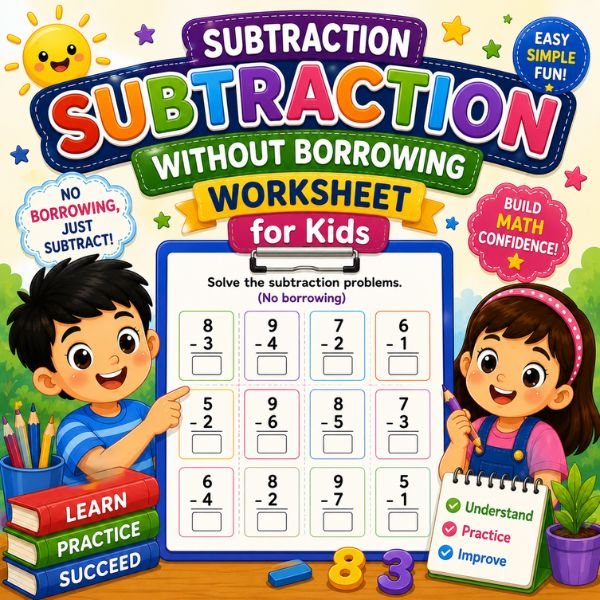
Free printable subtraction without borrowing worksheet for Class 1 and Class 2 kids. Includes single digit, double digit, column subtraction, word problems, and fill-in exercises with no regrouping. Download PDF and print instantly.
- Category: Worksheets > Math > Subtraction
- Age: 6 to 8 years
- Grade: Class 1 / Class 2
- Format: Free Printable PDF
Description
What is a subtraction without borrowing worksheet? A subtraction without borrowing worksheet is a free printable maths activity for Class 1 and Class 2 children that covers subtraction problems where the digit being subtracted is smaller than or equal to the digit above it, so no regrouping is needed. For example: 57 − 23 = 34. It includes single-digit and double-digit subtraction problems, column subtraction, and simple word problems. Regular practice builds subtraction fluency and prepares children for subtraction with borrowing.
What is the Subtraction Without Borrowing Worksheet?
This subtraction without borrowing worksheet helps children in Class 1 and Class 2 practise subtraction problems where no regrouping is required. Each problem is carefully chosen so that the digit being subtracted is smaller than or equal to the digit above it in every column. This makes the worksheet ideal for beginners who are learning column subtraction for the first time.
The worksheet is designed for children aged 6 to 8 years. Parents and teachers can download and print it for free and use it at home or in the classroom for daily maths practice.
What is Included in This Worksheet?
This free worksheet includes the following exercises:
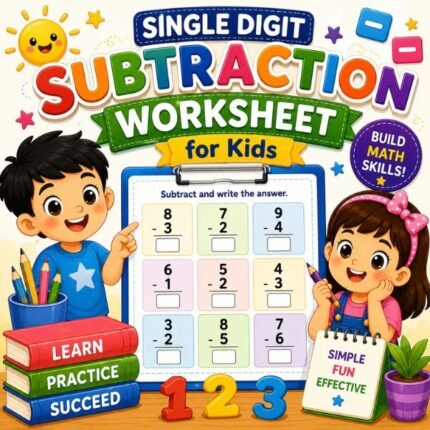
- Single Digit Subtraction — Simple problems like 9 − 4 = ?, 7 − 3 = ?
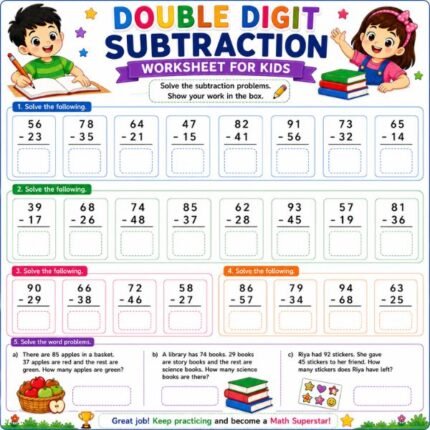
- Double Digit Subtraction (No Borrowing) — Problems like 45 − 23 = ?, 78 − 54 = ?
- Column Subtraction — Vertical format subtraction problems without regrouping
- Fill in the Blanks — Complete: 6 − __ = 2, 8 − __ = 5
- True or False — Is 9 − 4 = 5? Is 37 − 12 = 24?
- Missing Minuend or Subtrahend — Find the missing number in the equation
- Word Problems — Simple real-life subtraction problems without borrowing
- Subtraction Grid — Subtract across rows and down columns
Worksheet Comparison Table
| Feature | Without Borrowing | With Borrowing |
| Definition | Digit above is ≥ digit below in each column | Digit above is < digit below, regrouping needed |
| Example | 57 − 23 = 34 | 52 − 27 = 25 |
| Difficulty | Beginner | Intermediate |
| Grade Level | Class 1 / Class 2 | Class 2 / Class 3 |
| Skill Built | Subtraction fluency | Regrouping and borrowing |
Worksheet Exercise Types
| Exercise Type | What the Child Does | Best For |
| Single Digit Subtraction | Simple problems like 9 − 4 = ?, 7 − 3 = ? | Class 1 |
| Double Digit Subtraction (No Borrowing) | Problems like 45 − 23 = ?, 78 − 54 = ? | Class 1 |
| Column Subtraction | Vertical format subtraction problems without regrouping | Class 1 |
| Fill in the Blanks | Complete: 6 − __ = 2, 8 − __ = 5 | Class 1 |
| True or False | Is 9 − 4 = 5? Is 37 − 12 = 24? | Class 1 |
| Missing Minuend or Subtrahend | Find the missing number in the equation | Class 1 |
| Word Problems | Simple real-life subtraction problems without borrowing | Class 1 |
| Subtraction Grid | Subtract across rows and down columns | Class 1 |
Skills Developed by This Worksheet
| Skill Developed | How This Worksheet Helps |
| Subtraction Fluency | Regular practice of no-borrowing problems builds speed and accuracy in basic subtraction. |
| Column Subtraction | Vertical format problems teach children to align digits in ones and tens columns correctly. |
| Number Sense | Understanding that subtraction reduces a quantity builds fundamental number relationships. |
| Problem-Solving | Word problems teach children to identify what is being subtracted in real-life contexts. |
| Borrowing Readiness | Mastering without-borrowing subtraction is the essential prerequisite for learning borrowing. |
| Mental Maths Speed | Repeated practice increases calculation speed and reduces dependence on finger counting. |
How to Use This Worksheet
- Download the free PDF from this page.
- Print on A4 plain white paper.
- Start with single digit subtraction to build confidence.
- Move to double digit column subtraction once single digit is comfortable.
- Introduce word problems after the number exercises are mastered.
- Practise one section daily for 10 to 15 minutes.
Tips for Parents and Teachers
- Teach children to always start subtracting from the ones column (right side) first.
- Check each column: if the top digit is equal to or bigger than the bottom digit, no borrowing is needed.
- Use physical objects (blocks, counters) to show subtraction before moving to written exercises.
- Once this worksheet is mastered, introduce the Subtraction With Borrowing Worksheet.
Related Worksheets You May Also Like
➡️ Subtraction Worksheet for Grade 1
➡️Subtraction Without Borrowing Worksheet
➡️Single Digit Subtraction Worksheet
➡️Double Digit Subtraction Worksheet
➡️Subtraction With Borrowing Worksheet
➡️Subtraction Word Problems Grade 1
➡️Picture Subtraction Worksheet
➡️Missing Number Subtraction Worksheet
➡️Subtraction Facts Worksheet
➡️Subtraction Using Number Line Worksheet
Frequently Asked Questions
Q: What is subtraction without borrowing?
A: Subtraction without borrowing means subtracting numbers where the digit in each column of the top number is equal to or greater than the digit below it. No regrouping is needed. For example: 57 − 23 = 34. The ones column: 7 − 3 = 4. The tens column: 5 − 2 = 3.
Q: How do I know if a subtraction problem needs borrowing?
A: Look at the ones column first. If the top digit is equal to or bigger than the bottom digit, no borrowing is needed. If the top digit is smaller than the bottom digit, borrowing is required. For example: 57 − 23 needs no borrowing (7 > 3). But 52 − 27 needs borrowing (2 < 7).
Q: Which class learns subtraction without borrowing in India?
A: Subtraction without borrowing is taught in Class 1 and Class 2 in Indian schools under CBSE, ICSE, and State Board syllabi. It is covered in the NCERT Class 1 and Class 2 Maths textbooks as part of the Subtraction chapter.
Q: What exercises are included in this worksheet?
A: The worksheet includes single digit subtraction, double digit subtraction without borrowing, column subtraction, fill in the blanks, true or false, missing number, word problems, and a subtraction grid.
Q: Can I download the subtraction without borrowing worksheet PDF for free?
A: Yes. You can download the subtraction without borrowing worksheet as a free printable PDF from this page. No sign-up or payment required. Print and use at home or in school.

Reviews
There are no reviews yet.