
Blog
Addition With and Without Carrying — Full Guide for Parents

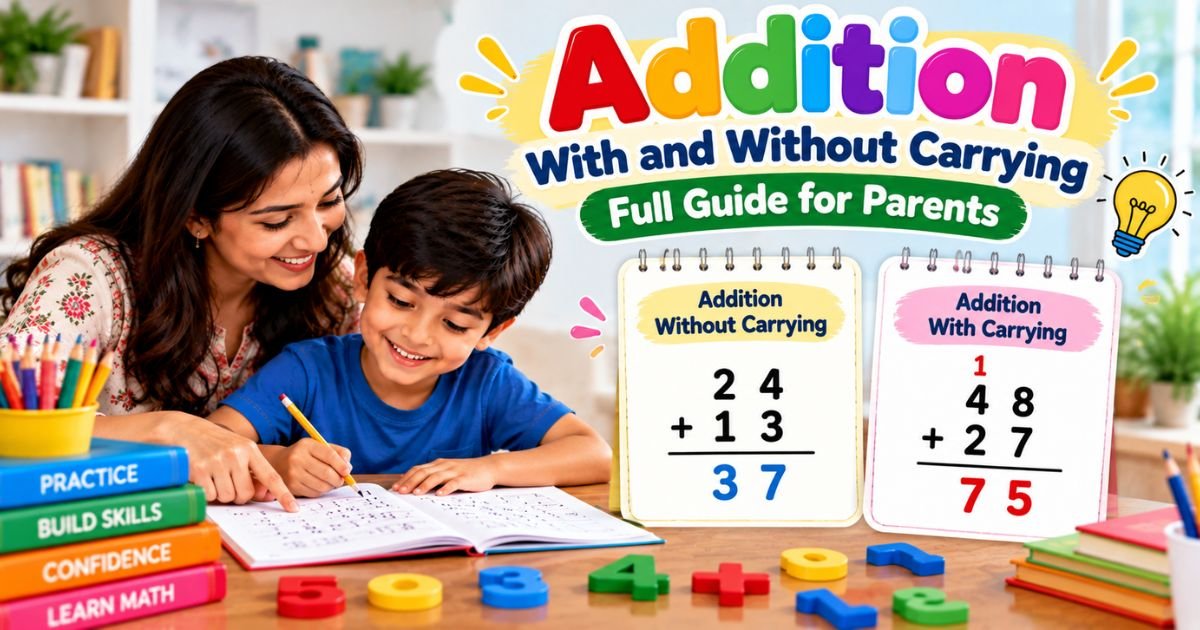
As children move from simple single-digit addition to two-digit sums, they encounter two types of addition — with carrying and without carrying. Many parents have heard these terms from teachers but are not always sure exactly what they mean or how to explain them to their child.
This guide explains both types clearly, shows worked examples, and tells you exactly how and when to teach each one at home.
What is Addition Without Carrying?
Addition without carrying — also called addition without regrouping — is when you add two or more numbers column by column and the digits in each column add up to 9 or less. No value needs to be moved (or ‘carried’) to the next column.
This is the type of addition taught in Grade 1 and is the foundation for all other addition.
Example 1: 23 + 14
2 3
+ 1 4
——-
3 7
Ones column: 3 + 4 = 7 (no carry needed)
Tens column: 2 + 1 = 3 (no carry needed)
Answer: 37
Example 2: 41 + 56
4 1
+ 5 6
——-
9 7
Ones column: 1 + 6 = 7 (no carry needed)
Tens column: 4 + 5 = 9 (no carry needed)
Answer: 97
💡 Key rule: If every column adds up to 9 or less — there is no carrying. The answer is written directly below each column.
What is Addition With Carrying?
Addition with carrying — also called addition with regrouping — is when the digits in a column add up to 10 or more. Because we cannot write a two-digit number in a single column, we write the ones digit of the sum in that column and ‘carry’ the tens digit to the next column on the left.
This is typically introduced in Grade 2 after children are very confident with addition without carrying.
Example 1: 27 + 15
2 7
+ 1 5
———
4 2
Ones column: 7 + 5 = 12
Write 2 in the ones place, carry 1 to the tens column.
Tens column: 2 + 1 + 1 (carried) = 4
Answer: 42
Example 2: 48 + 36
4 8
+ 3 6
———
8 4
Ones column: 8 + 6 = 14
Write 4 in the ones place, carry 1 to the tens column.
Tens column: 4 + 3 + 1 (carried) = 8
Answer: 84
💡 Key rule: When a column adds up to 10 or more — write only the last digit in that column and carry the 1 to the top of the next column to the left.
Addition With vs Without Carrying — Quick Comparison
| Aspect | Without Carrying | With Carrying |
|---|---|---|
| Also called | Addition without regrouping | Addition with regrouping |
| Column digit sum | 9 or less in every column | 10 or more in at least one column |
| Carrying needed? | No | Yes |
| Grade level | Grade 1 | Grade 2 onwards |
| Example | 23 + 15 = 38 | 27 + 15 = 42 |
| Difficulty | Beginner | Intermediate |
Why Children Must Learn Without Carrying First
Teaching addition with carrying before a child is confident with addition without carrying is one of the most common mistakes parents and tutors make. Here is why the order matters so much:
- Addition without carrying builds the habit of working column by column from right to left
- It establishes the understanding of place value — ones, tens, hundreds
- It gives children confidence with two-digit addition before complexity is added
- Children who skip this stage often make carrying errors because they do not have a stable column-by-column habit first
💡 Rule of thumb: Your child should be able to complete a 20-sum addition-without-carrying worksheet with 90% accuracy before you introduce carrying.
How to Teach Addition Without Carrying at Home
Step 1: Build place value understanding first — Use tens and ones blocks, bundles of sticks, or drawn grids. Show that 34 means 3 tens (30) and 4 ones (4). Children who understand place value find column addition much easier to grasp.
Step 2: Introduce the column format — Write sums vertically with a ones column and a tens column. Draw a line between the columns at first to help your child see which digits belong together. Always start adding from the ones column (right side).
Step 3: Add ones first, then tens — For 23 + 14: first add the ones (3 + 4 = 7), write 7 under the ones column. Then add the tens (2 + 1 = 3), write 3 under the tens column. Answer: 37. Repeat this sequence clearly every time until it is automatic.
Step 4: Check answers by counting forward — After solving, ask your child to verify by starting at 23 on a number line and jumping 14 places forward. Landing on 37 confirms the column addition was correct. This cross-checking builds number sense alongside column skills.
Step 5: Move to worksheets for daily practice — Once your child can do 3 to 4 sums correctly with guidance, introduce a short worksheet of 10 to 15 sums daily. Keep all sums within the without-carrying range until accuracy is consistently high.
How to Teach Addition With Carrying at Home
Step 1: Start with ones that make 10 or more — Begin with sums where only the ones column requires carrying, for example 17 + 15. This isolates the carrying concept before introducing sums where both columns may need attention.
Step 2: Explain what carrying means physically — Use 10 individual blocks or coins. When you have 12 ones, group 10 of them into one bundle of ten. That bundle goes to the tens column. The leftover 2 ones stay in the ones column. This physical action shows exactly what carrying means.
Step 3: Write the carry number clearly — Teach your child to write the carried digit as a small number at the top of the next column. This is a crucial habit — children who try to hold the carry in their head often forget it and get the wrong answer.
Step 4: Always add the carried digit last — In the tens column, add the two main digits first, then add the carried 1. For 27 + 15: tens column is 2 + 1 = 3, then add the carried 1 to get 4. Doing it in this order reduces confusion.
Step 5: Practise with double-digit worksheets — Once your child can work through carrying with guidance, move to structured worksheets. Start with sums where only the ones column carries. Introduce sums where both columns carry only after full confidence with single carries.
Common Carrying Errors to Watch For
- Forgetting to add the carried digit to the next column — the most common error. Fix: always write the carry number at the top of the next column in pencil.
- Carrying when not needed — happens when a child applies the carrying rule automatically even when the column sum is less than 10. Fix: reinforce checking if the column sum reaches 10 before deciding to carry.
- Adding the carried digit to the wrong column — the child writes the carry in the ones column instead of the tens. Fix: use clearly drawn column grids with labelled headers (O for ones, T for tens).
- Writing the tens digit in the answer instead of the ones digit — for 7 + 5 = 12, some children write 12 in the ones column. Fix: remind them that only the ones digit (2) stays, and the ten (1) is carried.
FAQ
They mean exactly the same thing. ‘Carrying’ is the older, more common term used in India and the UK. ‘Regrouping’ is the term used in many modern textbooks. Both refer to moving the tens digit from one column to the next when a column sum reaches 10 or more.
Most children are introduced to addition with carrying in Grade 2, around age 7. Before that, Grade 1 focuses entirely on addition without carrying. Do not introduce carrying until your child is very confident with two-digit addition without carrying.
Make it a habit to always write the carried digit as a small number at the top of the next column. Never try to hold it in memory. Once writing the carry becomes automatic, forgetting it becomes very rare.
Not exactly. Simple addition usually means single-digit sums (3 + 4). Addition without carrying covers two-digit sums where no regrouping is needed (23 + 14). Both are simpler than addition with carrying, but they are slightly different levels.
This is not recommended. Carrying is built entirely on place value — the idea that digits in the tens column represent groups of ten. If a child does not understand this, carrying becomes a meaningless trick they apply randomly. Always secure place value first.
For Grade 1 (without carrying), 10 to 15 sums per day is enough. For Grade 2 (with carrying), start with 8 to 10 carefully done sums and increase as confidence grows. Quality and accuracy matter more than quantity at this stage.
➡️How to Teach Addition to Grade 1 Kids at Home
➡️Why Kids Make Mistakes in Addition and How to Help Them
➡️Addition With and Without Carrying — Full Guide for Parents
➡️Fun Ways to Practice Addition at Home Without Boring Drills
➡️Addition Word Problems — How to Help Kids Understand Them
➡️Addition Worksheet for Grade 1
➡️Addition Without Carrying Worksheet
➡️Single Digit Addition Worksheet
➡️Double Digit Addition Worksheet
➡️Addition With Carrying Worksheet
➡️Addition Word Problems Grade 1
➡️Picture Addition Worksheet
➡️Missing Number Addition Worksheet
➡️Addition Facts Worksheet
➡️Addition Using Number Line Worksheet
3 thoughts on “Addition With and Without Carrying — Full Guide for Parents”