
Blog
Addition Word Problems — How to Help Kids Understand Them

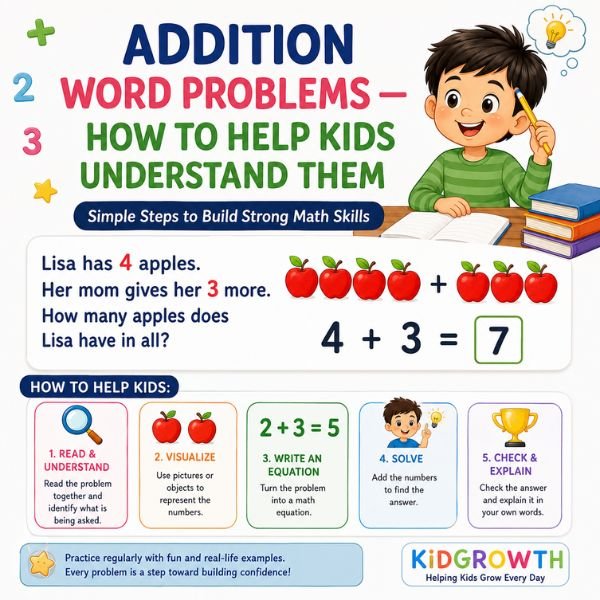
Addition word problems are math questions written as short stories or real-life situations where a child must identify two numbers and add them together to find the answer. They are typically introduced in Grade 1 (age 6–7) and teach children to apply addition skills to everyday situations rather than abstract number sentences.
Does your child sail through addition worksheets but freeze the moment a word problem appears? This is one of the most common challenges in Grade 1 math — and it has nothing to do with intelligence.
Word problems require a child to do two things at once: read and understand the situation, then figure out the math. That is a very different skill from solving 3 + 4 on a blank worksheet.
This guide explains what addition word problems are, why children struggle with them, and how to teach the skill step by step at home.
📖 What is an Addition Word Problem?
Also known as: math story problem, addition story sum, verbal math problem
An addition word problem is a written description of a real-life situation that requires the reader to identify two or more quantities and add them to find a total. Unlike a bare number sentence (3 + 4 = ?), a word problem embeds the numbers inside a sentence or short story that the child must first read and interpret.Why it matters: Word problems build the ability to connect mathematical operations to real-world contexts — a skill assessed in all school examinations from Grade 1 onwards.
Examples of Addition Word Problems (Grade 1 Level)
Here are simple examples of addition word problems appropriate for Grade 1 children (age 6–7):
Example 1 (Single digit):
“Riya has 4 apples. Her mother gives her 3 more. How many apples does Riya have now?”
Number sentence: 4 + 3 = 7
Example 2 (Two digit, no carrying):
“There are 12 boys and 6 girls in a class. How many children are there altogether?”
Number sentence: 12 + 6 = 18
Example 3 (with total unknown context):
“Arjun scored 5 goals in the first half and 4 goals in the second half. How many goals did he score in total?”
Number sentence: 5 + 4 = 9
📌 Fact: In the CBSE and ICSE Grade 1 curriculum (age 6–7), children are expected to solve single-digit and simple two-digit addition word problems. Word problems are assessed in all major school examinations from Grade 1 onward.
Why Children Struggle With Addition Word Problems
Struggling with word problems does not mean a child is bad at math. It usually means one or more of the following skills needs more development.
⚠️ They can do sums but not word problems
Why: The child understands addition as a mechanical operation but has not yet learned to identify the operation from a written description. Reading the problem and extracting the numbers is a separate skill from calculating.
Fix: Practise identifying the key words in a sentence before solving. Words like “altogether”, “in total”, “combined”, and “how many more” are signal words that indicate addition. Teach these words explicitly.
⚠️ They add all numbers they see, even when wrong
Why: Children who are unsure what to do often default to adding every number mentioned in the problem. For example, if a problem says “Priya is 6 years old and has 3 sisters”, some children write 6 + 3 without understanding the context.
Fix: Slow the reading process down. Ask your child to explain what the story is about before picking up a pencil. Can they retell it in their own words? If they cannot explain it, they are not ready to solve it.
⚠️ They struggle to write the number sentence
Why: Some children understand the story and can say the answer verbally but cannot translate it into the format “? + ? = ?”. This is a bridging skill between language and symbolic math.
Fix: Practise writing number sentences separately from solving them. Give your child a simple story and ask only: “Write this as a number sentence.” Do not ask for the answer yet. Once number sentence writing is fluent, solving follows naturally.
⚠️ Reading difficulty slows or blocks problem-solving
Why: If a child’s reading is not yet fluent, decoding the words takes so much effort that no mental capacity is left for the math. This is not a math problem — it is a reading-math overlap issue.
Fix: Read the word problem aloud to your child. Ask them to focus only on the math while you handle the reading. Gradually shift responsibility to the child as their reading confidence grows. Never let reading difficulty be mistaken for math difficulty.
📖 Key Signal Words in Addition Word Problems
Also known as: addition trigger words, math operation keywords
Signal words are specific words or phrases in a word problem that indicate which mathematical operation to use. For addition word problems, the most common signal words are: altogether, in total, combined, how many in all, sum, more than, added to, both together, and increased by.
Why it matters: Teaching signal words explicitly is one of the most effective methods for helping Grade 1 children identify the correct operation in word problems. Research in early mathematics education consistently identifies signal word awareness as a key predictor of word problem success.
How to Solve Addition Word Problems — 4-Step Method for Kids
⚡ The 4-Step Method for Solving Addition Word Problems (Grade 1)
Step 1: Read — Read the problem carefully or listen as it is read aloud. Step 2: Understand — Retell the story in your own words. What is happening? Step 3: Find the numbers — Circle the two numbers you need to add. Step 4: Solve and write — Write the number sentence and calculate the answer.
1. Read: Read the entire problem before doing anything else. If your child is still developing reading skills, read it aloud to them clearly and slowly. Ask: “What is this story about?”
2. Understand: Ask your child to retell the problem in their own words without looking at it. This confirms they have understood the situation — not just decoded the words. If they cannot retell it, re-read together.
3. Find the numbers and the signal word: Ask: “What are the two numbers in this story?” and “Which word tells us to add?” Help your child circle or underline the two numbers and the signal word (altogether, in total, etc.) before writing anything.
4. Write the number sentence and solve: Write the number sentence in the format: ? + ? = ___. Fill in the two numbers found in Step 3. Then calculate the answer using objects, fingers, or a number line. Write the answer clearly.
💡 The most important step is Step 2 — understanding the story. Children who rush to numbers without understanding the situation almost always get word problems wrong.
How to Teach Addition Word Problems at Home — Step by Step
Step A: Start with verbal problems (no reading) — Make up simple addition stories orally before introducing written word problems. “You have 3 biscuits and I give you 2 more — how many do you have now?” This isolates the math skill from the reading skill. Once your child can solve oral word problems confidently, move to simple written ones.
Step B: Use your child’s name and interests — Replace generic names with your child’s name and use topics they love — cricket, Doraemon, sweets, toys. Personalised word problems hold attention longer and are solved more accurately because the child is genuinely engaged.
Step C: Draw the problem first — Before writing a number sentence, ask your child to draw a simple picture of the story. For “4 apples and 3 apples”, they draw 4 circles and then 3 more. Counting the total drawing reinforces the concept physically before moving to abstract symbols.
Step D: Introduce the signal word list — Write 5 to 6 addition signal words on a small card: altogether, in total, how many in all, combined, both together, added to. Keep this card visible during word problem practice. Over time your child will internalise these words and no longer need the card.
Step E: Move to printed worksheets gradually — Begin with 2 to 3 word problems per session. Use worksheets that present one problem at a time with space to draw, write the number sentence, and write the answer. Increase to 5 and then 8 problems as confidence builds.
📌 Fact: Child development research shows that children who are taught to retell a problem before solving it solve word problems with significantly higher accuracy than those who proceed directly from reading to calculation. This metacognitive step is the single most impactful teaching intervention for word problem performance.
Three Types of Addition Word Problems Kids Should Know
Type 1: Join / Put Together
Two separate groups are combined to make one total. This is the most common type in Grade 1.
Example: “There are 5 red balls and 4 blue balls. How many balls are there altogether?”
Type 2: Add To / Increase
A starting quantity increases when more is added. The child must identify the starting number and the amount added.
Example: “Preet had 7 stickers. She bought 5 more. How many stickers does she have now?”
Type 3: Compare (how many more / in total)
Two quantities are described and the child must find the combined total or the larger amount. This type is slightly harder and is usually introduced in the second half of Grade 1.
Example: “Rohan has 6 pencils and his sister has 4 pencils. How many pencils do they have in total?”
💡 Start with Type 1 (join/put together) and practise it until it is comfortable. Move to Type 2, then Type 3. Mixing types too early creates confusion about what the problem is asking.
Common Mistakes Parents Make When Teaching Word Problems
- Jumping to written problems before oral problems are mastered — always start with spoken stories
- Correcting wrong answers without asking the child to explain their thinking first
- Doing the reading for the child every time — gradually shift responsibility to the child as reading improves
- Using word problems that are too long or complex for the child’s current reading level
- Mixing addition and subtraction word problems too early — keep them separate until both are solid individually
- Skipping the draw-it step because it feels slow — drawing is often what makes the concept click
Practice Resources
Support your child’s word problem skills with these free printable worksheets:
- Addition Word Problems Grade 1 — kidgrowth.co.in/worksheets/math/addition/addition-word-problems-grade-1/ — Graded word problems with space to draw, write the number sentence, and solve
- Addition Worksheet for Grade 1 — kidgrowth.co.in/worksheets/math/addition/addition-worksheet-for-grade-1/ — Structured sums to build the calculation confidence word problems rely on
FAQ
Addition word problems are short stories or real-life situations where a child must find two numbers and add them to get a total. They are introduced in Grade 1 (age 6–7) and teach children to apply addition to everyday contexts rather than just solving bare number sentences on a worksheet.
The most common addition signal words are: altogether, in total, combined, how many in all, both together, added to, sum of, and increased by. Teaching these words explicitly helps Grade 1 children quickly identify that a problem requires addition before they begin solving it.
Solving a number sentence (3 + 4 = ?) and solving a word problem are different skills. Word problems require reading comprehension and the ability to extract numbers from a story before calculating. A child who can add but struggles with word problems needs practice specifically in reading and interpreting math stories, not more calculation drills.
Start with oral word problems before written ones. Teach the 4-step method: Read, Understand (retell), Find the numbers and signal word, then Write the number sentence and solve. Ask your child to draw the problem first. Use their name and interests to make stories engaging and familiar.
Most children are introduced to simple addition word problems in Grade 1, around age 6 to 7. In the CBSE and ICSE curricula, single-digit word problems typically appear in the first term, with simple two-digit word problems following in the second term of Grade 1.
For beginners, 2 to 3 word problems per session is enough. Each problem should be worked through fully using the 4-step method — read, retell, find numbers, solve. As confidence builds over 2 to 3 weeks, gradually increase to 5 and then 8 problems per session.
In early Grade 1, reading word problems aloud to your child is fine. This separates the reading skill from the math skill and prevents reading difficulty from being mistaken for math difficulty. Gradually shift responsibility to the child as their reading confidence and fluency improve over the school year.